How to analyse a taekwondo opponent and what to write down
In this article
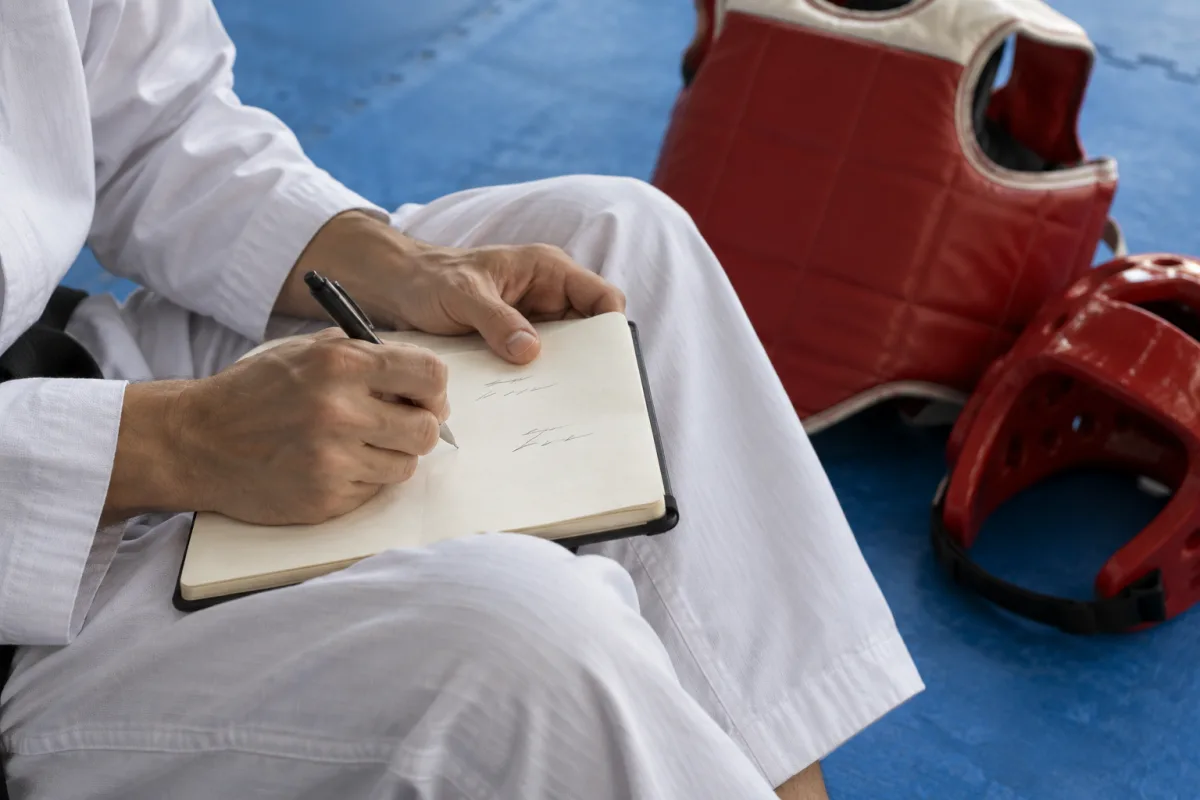
When you come off the mat, write down two things while they are still fresh: what scored against you, and what your opponent did each time you stepped in. Did a front-leg cut kick stop you? Did they wait for your kick and answer with a back kick? Did they switch their lead leg just before going to the head? Most of what you can learn about a taekwondo opponent is in those answers, and they fade quickly once you start warming up for your next fight.
Put the answers on an opponent page so they are waiting when you meet again. In your weight class you will often face the same opponent more than once at regional and national championships and open tournaments, and the clubmate you spar with every week deserves a page as well. Ahead of the rematch, you and your coach can work from that page and settle on two things to try.
How does your opponent stand and move?
Start with the lead leg. Left lead or right lead, and when did they switch: before attacking, after you scored, near the line, late in a round? Add your own lead leg too, so you know whether you were in open stance (different lead legs) or closed stance. That changes which kicks each of you has available. Note which kicks they used in each stance, and treat one bout as a first sighting rather than a fixed label.
Then distance. Did they want to fight at kicking range or come in close? How did they step in and get out again?
Look at where they fought on the mat as well. Some fighters hold the centre; others work off the edge and invite you onto the line. When you pressed them towards the boundary, did they step out, slide along the line or come back to the centre? And did they push you towards it?
Do they attack first or wait to counter?
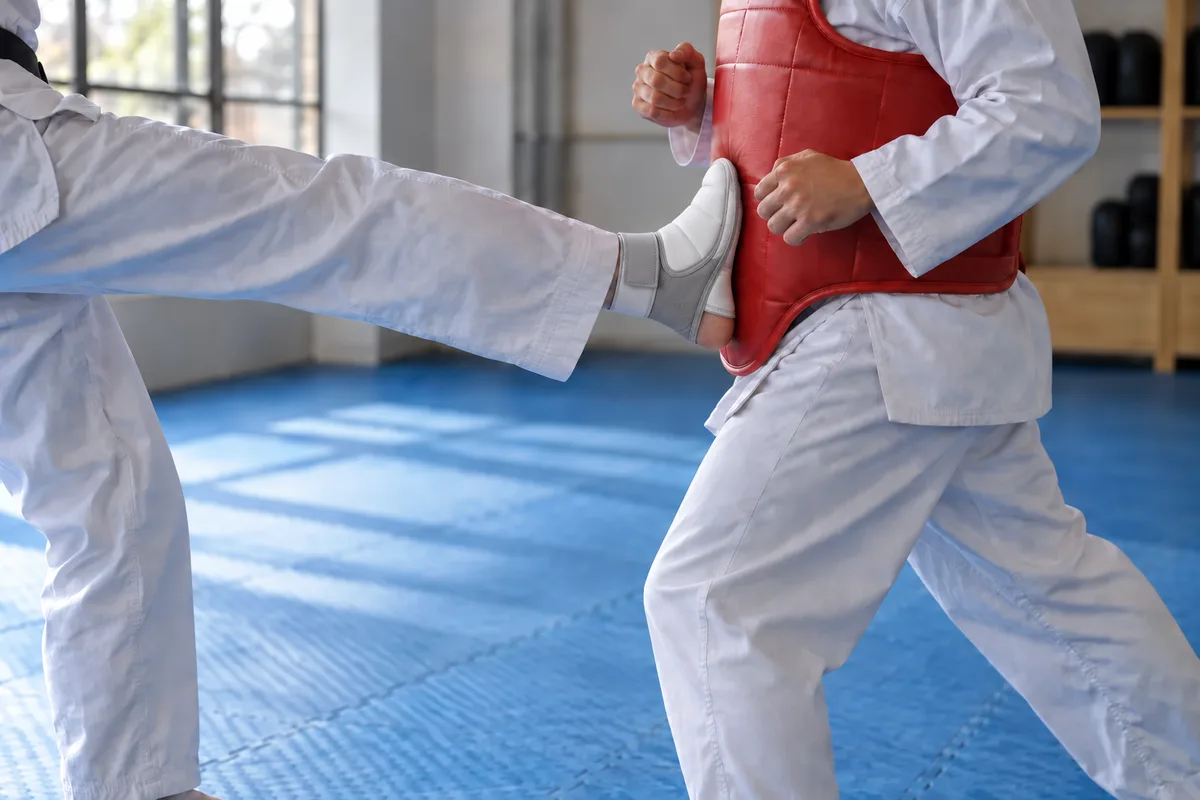
Watch the front leg. Did they use it to keep you out, with a cut kick to the body every time you stepped forward? Or to score, or to set up something else? Write down what followed the cut kick, if anything.
Who started the exchanges? Did they attack, or wait for you? If they countered, when?
- Some counter as your knee comes up, before your kick is out.
- Some kick at the same moment you do.
- Others let your kick go past and answer it, often with a back kick or a spinning kick.
Note which of your attacks drew a counter, and what it was.
Keep a separate line for what actually scored, on both sides:
- roundhouse, back kick, spinning kick or punch
- front leg or rear leg
- body or head
That line is worth more than an impression of how busy someone was, and the studies below suggest why.
Head kicks deserve their own note. When did they go to the head? Off a switch, after a cut kick, from close range? And what were you doing at that moment? If the answer is “dropping my rear hand as I lifted my knee”, that line is about your guard, not theirs, and it is something you can fix in training.
At close range, what did they do? Punch, throw short kicks, push, hold? How did they get out? Fighters who look ordinary at kicking range can be very different when you are chest to chest.
Who scored first, and what changed between rounds?
Note who scored first in each round and how the opponent began it: straight at you, or waiting. What changed after they won a round, or lost one? What did they do in the last part of a round when they were ahead, and when they were behind? Stick to actions, not moods. “Kept me at distance with cut kicks for the rest of the round” is something you saw; “she was rattled” is mind-reading.
Penalties belong here too: which ones they collected (stepping over the line, falling, holding) and which ones they drew from you. If you remember what your coach told you between rounds, add it.
Record the result as it was announced, for example 2–1 in rounds, and leave out reconstructed scores. You can leave the rule book shut — it changes, and the page only has to record what happened.
What can you test against the patterns you see?
Notes earn their keep when they turn into something to try. These four patterns come up often in taekwondo bouts. Under each are ideas to test with your coach, in paddle work and in supervised sparring. They are options, not answers, so each one also says when to drop it.
- Stops you with the front leg. Every time you step in, you run into a cut kick to the body and your attack never gets going. Try drawing the cut with a half step and attacking as their leg comes down, or getting close before you kick. Drop it if they stop cutting and simply counter, or if the cut still stops you.
- Waits and counters. They rarely start anything and answer your attacks with a back kick, a spinning kick or a counter roundhouse. Try opening with a feint or a half-committed kick to draw the counter, then attacking as it finishes. Or swap straight-line attacks with the rear leg for quicker front-leg kicks that leave less to counter. Drop it if they stop reacting to the feint, or if the counter still lands.
- Presses you towards the line. They keep coming forward and closing the gap until you end up at the boundary. Two things to try: meet their step-in early with a front-leg kick or a counter, and move off at an angle instead of straight back. Drop them if you still end up on the line, or if you start collecting penalties.
- Goes to the head off a set-up. The head kick comes off a switch or straight after a cut kick, often when you drop your rear hand as you lift your knee. Try treating the switch or the cut as your cue — keep that hand up, or attack at the moment they switch. Drop it if the head kick starts coming from a different set-up, or if your own attacks dry up.
Pick one or two ideas for the next meeting, and only where your notes show the pattern. One bout gives you a hypothesis, not a label. The example further down puts two of them to work against one opponent.
What have studies of taekwondo bouts found?
Cristina Menescardi of the University of Valencia and colleagues coded all 151 bouts of the London 2012 Olympic tournament for the Journal of Human Sport and Exercise (2021). More than nine in ten offensive actions scored nothing. Early counters, kicking as the opponent lifts the knee to attack, were the tactic most associated with scoring, and rear-leg kicks were more effective than front-leg kicks. The data come from one elite tournament under 2012 rules, when corner judges rather than sensors scored head kicks.
Her group’s earlier study, from the Catholic University of Valencia and the University of Málaga, covered 169 bouts at a national university championship (Journal of Strength and Conditioning Research, 2015). Winners made fewer direct and indirect attacks than losers, and more counterattacks. A fighter who is ahead may simply be waiting, so this shows what winners did, not that countering wins.
Minsoo Jeon of Dankook University and Hyosung Lim of Anyang University analysed 272 women’s matches at the 2022 World Championships (BMC Sports Science, Medicine and Rehabilitation, 2024). Winners threw about as many kicks as losers but scored more often to the body and the head, from attacks and counters alike. The sample is elite women at one championship.
Yun Ho Kim of Sangmyung University in Seoul and colleagues studied 382 matches from the 2023 World Championships and Grand Prix (International Journal of Sports Science & Coaching, 2025). More than 70% were over in two rounds. Scoring first was strongly associated with winning rounds, though that may simply reflect the stronger fighter scoring first.
All four studies are observational, so none of them can show cause and effect. Taken together, they still point your notes towards three things: what scored, who started the exchanges and who scored first in each round.
What goes on the page?
Our recommendation: after every bout, answer three questions — what worked, what didn’t work and what you will do next time. We think these are the most important things to note in any combat or racket sport. The first two headings, context and the opponent, hold the details your answers rest on. None of the studies above looked at whether keeping notes improves taekwondo results.
- Context. Event and stage, or club sparring; opponent and weight class; both lead legs; the announced result; your source for each detail: memory, a clip or your coach.
- The opponent. Their lead leg and when it changed; kicking range or close range; centre or edge, and what they did near the line; what they started with and how they countered; what scored against you (technique, leg, body or head); how they set up head kicks; what happened at close range; who scored first in each round and what changed; penalties.
- What worked. What scored for you and what kept you out of trouble.
- What didn’t work. Where you got caught and what you did just before; the habit you kept repeating.
- What to do next time. Two changes to try, and for each, what would make you drop it.
The number is not fixed, but one or two changes are usually enough for a single bout; each one you add complicates the plan before you have thrown a kick. Where you cannot remember, leave the gap rather than guess. A spot marked on a sketch of the contest area needs a few words on what happened there, or it tells you nothing next time.
What does a filled-in page look like?
The page below is an invented teaching example — neither fighter is real, and none of it is research data.
Context: Quarter-final at the regional championships, best of three, against Fiona. We had sparred once before, when her club visited ours. Her left lead against my right, so open stance. Lost 2–1 in rounds. From memory, plus my coach’s comments between rounds and a clip of rounds two and three on a teammate’s phone.
The opponent: Left lead for most of the bout. Wanted kicking range. First round, every time I stepped in she met me with a front-leg cut kick to the body and stopped me. When I went straight in with a rear-leg roundhouse, she answered with a back kick that scored. In the third she scored first with a head kick off a switch, then kept me at distance with cut kicks for the rest of the round. When I pressed her to the line in the third, she slid along it back towards the centre instead of stepping out. I wasn’t counting kicks.
What worked: Won the second round by getting close before kicking — punches and a short kick to the body scored, and her cut kick did nothing to stop it. She can be scored on.
What didn’t work: Kept attacking straight in with the rear leg and walked onto the back kick. Dropped my rear hand as I lifted my knee, and that is when the head kick came.
Next time: Instead of going straight in, draw the cut kick with a half step and attack as her leg comes down. Drop it if she stops cutting and just waits to back-kick, or if the back kick still lands when I attack after the cut. Get to close range early in every round, as in the second. Drop that if she moves away along the line before I get there, or if close range starts costing me penalties for pushing or holding.
What the page captures is a sequence: cut kick on the step in, back kick against the straight attack, head kick off a switch once the rear hand drops. A few remembered exchanges are clues to check, not odds for next time. Use the clip to check the notes on rounds two and three. Leave the second round in — it is the part that shows what worked.
How do you take the notes into training and the rematch?
Your coach can help turn each change into practice: paddle work on attacking as the cut kick comes down, and supervised sparring with a partner who imitates the cut kick and the back-kick counter. In both, work on keeping your rear hand up as your knee lifts.
In the rematch, the first exchanges will tell you whether she still cuts when you step in. Since you last met, she may have switched her lead leg, moved up a weight class or changed her style, and you will not fight exactly as you did either.
After the rematch, update the page: what worked, what did not and what you are still unsure of. Do it while the rounds are still clear in your head, and leave numbers out unless you actually counted. There is no fixed point after which a bout is forgotten — our article on match memory explains why recall still deserves care.
Look across your opponent pages as well. If back-kick counters catch you whenever you attack in a straight line, whoever the opponent, that is something to fix in training rather than plan around at the next event. What reviewing your own bouts can and cannot do is set out in our article on the research on reflection and sporting performance; none of that research shows that writing things down is what makes you improve.
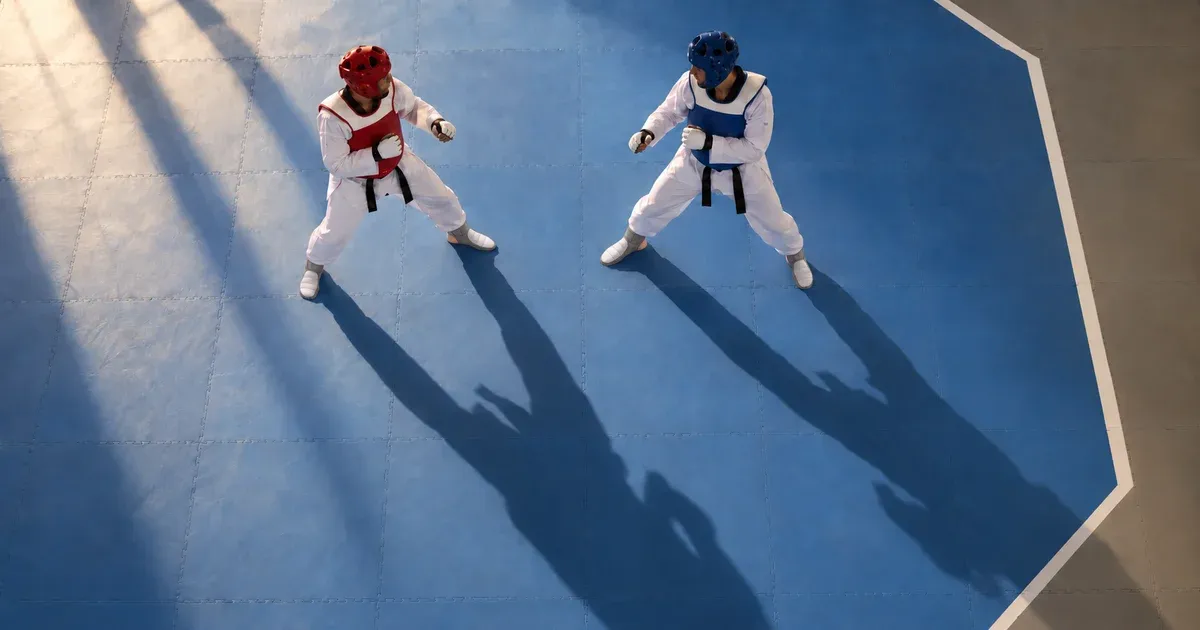
For taekwondo, OpponentBook’s free journal gives you a drawing of the octagonal contest area. Pins go anywhere on it. Each one is marked as worked, didn’t work, dangerous or a tendency, and carries a note. Optional profile fields cover WT or ITF, weight class, belt or grade, stance (left lead, right lead or switch) and the techniques the opponent scores with, from roundhouse and cut kick to spinning kicks and punches.
Synced records are saved in the storage you connect; OpponentBook’s account database does not hold a copy of your journal. When you request AI processing, the necessary content passes through an OpponentBook server to the AI provider. Optional end-to-end encryption protects encrypted records from the storage provider, while photos, videos and provider-visible file metadata remain outside that protection. The privacy guide explains these distinctions.
Tonight, take your most recent bout or sparring session and write down what scored against you and what your opponent did each time you stepped in. Then add what worked for you, what didn’t and the two changes you will take into the next meeting.