Reflection and sporting performance: what the studies actually show

In this article
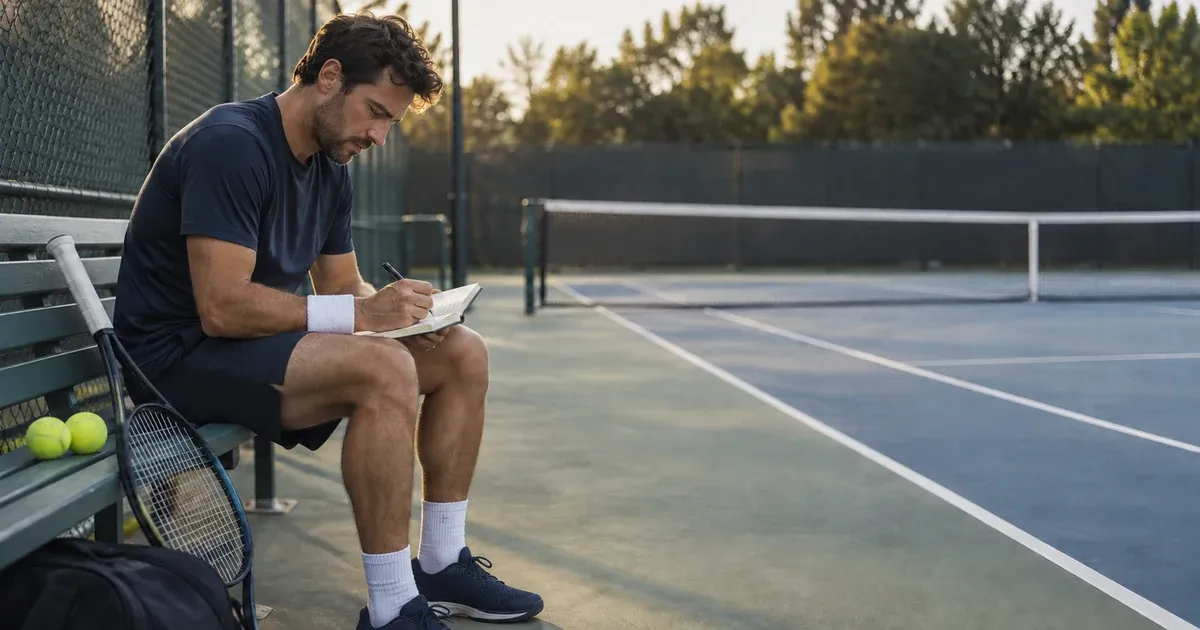
A useful review of a match might leave you with a training question: why did a particular receive keep rising, or what happened before you lost position? Writing can make that question easier to revisit. Whether a journal improves sporting results is a different claim, and the studies below do not directly establish it.
What researchers observed in athletes
In 2009, Tynke Toering and colleagues at the University of Groningen compared 159 elite and 285 non-elite youth soccer players in Journal of Sports Sciences. Questionnaire scores for reflection and effort were associated with playing at elite level. The study measured self-reports; it did not assign players a writing routine.
In 2012, Laura Jonker and colleagues published findings from 52 young elite athletes followed over two and a half years in The Sport Psychologist. Earlier reflection scores were associated with later attainment. A characteristic preceding success is worth investigating, but it does not by itself establish a cause. Neither study showed that writing outperforms thinking, or that a journal decides otherwise evenly matched contests.
Practice theory provides context
Anders Ericsson’s 1993 account of deliberate practice in Psychological Review emphasizes demanding practice designed to improve specific skills, with feedback. A notebook might help you retain a coach’s question or record what you tried. That possible use is not the same as a demonstrated mechanism from writing to improvement.
The research is also debated. Macnamara and Maitra’s 2019 violin-study replication in Royal Society Open Science did not reproduce the original pattern of practice time across all skill groups. It concerns musicians and cannot settle the effectiveness of an athlete’s journal.
Writing research asks other questions
A 2022 systematic review of 20 journaling studies in Family Medicine and Community Health examined mental-health outcomes. Results varied substantially between studies, and the clinical importance of the effects was uncertain. Those findings are not a trial of match preparation or evidence for a winning margin.
James Pennebaker’s 2018 article in Perspectives on Psychological Science is a short retrospective on expressive-writing work. It is not a systematic review of four decades, nor a direct comparison showing that a particular sports template beats private reflection or emotional expression.
Turn the review into a question
You can still try a modest routine without claiming more than the evidence supports. After a match, record what worked, what did not and what to try next. Include context and uncertainty. Before training, choose an example to discuss with a coach; after the next attempt, add what happened.
An opponent page can help you find related encounters. A repeated phrase is a prompt to investigate, not proof of a fixed weakness. Likewise, comparing your recorded wins with and without a pre-match review cannot isolate the effect of reviewing.
OpponentBook keeps opponent notes, matches and training together. Your records stay on your device and connected storage; the privacy explanation distinguishes this from requested AI processing. The routine itself needs no app. Try it on paper if that makes it easier to begin.