
Wrestling strategy for the rematch: what to note after every match
In this article
Plenty of wrestlers lose to the same thing all season. They get taken down by the same single leg, lose the same hand-fight, get snapped down from the same collar tie or turned by the same gut wrench. More hours in the room do not always fix that on their own.
In our view, few habits do more for your match tactics than looking back at each match and writing down what it taught you. An opponent book gives that habit a home — a paper notebook, or an app such as OpponentBook, with a separate page for each wrestler you face. You add to the page after every match against them and read it before the next one.
The heart of each entry is three answers: what worked for you, what did not, and what you will do the next time you meet. Around them goes just enough about the opponent to make sense of the answers months later: how they stand, how they tie up, what they shoot and off what, and what they do on top and underneath.
Rematches are common in wrestling. You might meet someone again at the next tournament in your weight class, at regionals and then at nationals, or in the next dual meet, and you may wrestle a teammate in your own room every week. When you face them again, a page of notes is worth more than a vague memory of losing 7–4. Here is what we suggest you watch for and write down.
What should every match entry answer?
We recommend the same three notes after every match: what worked, what didn’t work and what you will do next time. We think they are worth more than anything else on the page, in wrestling and in every other combat or racket sport. They are also the three questions in OpponentBook’s match form.
- What worked. Anything that scored for you or kept you out of trouble, even if it happened once. Example: “When I got to his wrists first, he never got the collar tie, and my single leg on his lead leg scored.”
- What didn’t work. How they scored on you, whether they took you down, turned you or pushed you out. Example: “Reached for the collar tie from too far away. He shot a single leg underneath it.”
- Next time. One or two things to carry into the rematch: a change, or something that worked and deserves a repeat. Example: “Hands on his wrists before he gets the collar tie. Drop it if he stops tying up and shoots straight away.”
How many is up to you, but one or two is usually plenty. A long list makes the plan complicated before the first whistle.
How do they stand, and what do they tie up with?
Stance first: square or staggered, which side leads, and whether it changed when they attacked, once they were ahead, or late on. Add your own lead side if the match-up matters. One match shows how they stood that day, not how they always stand.
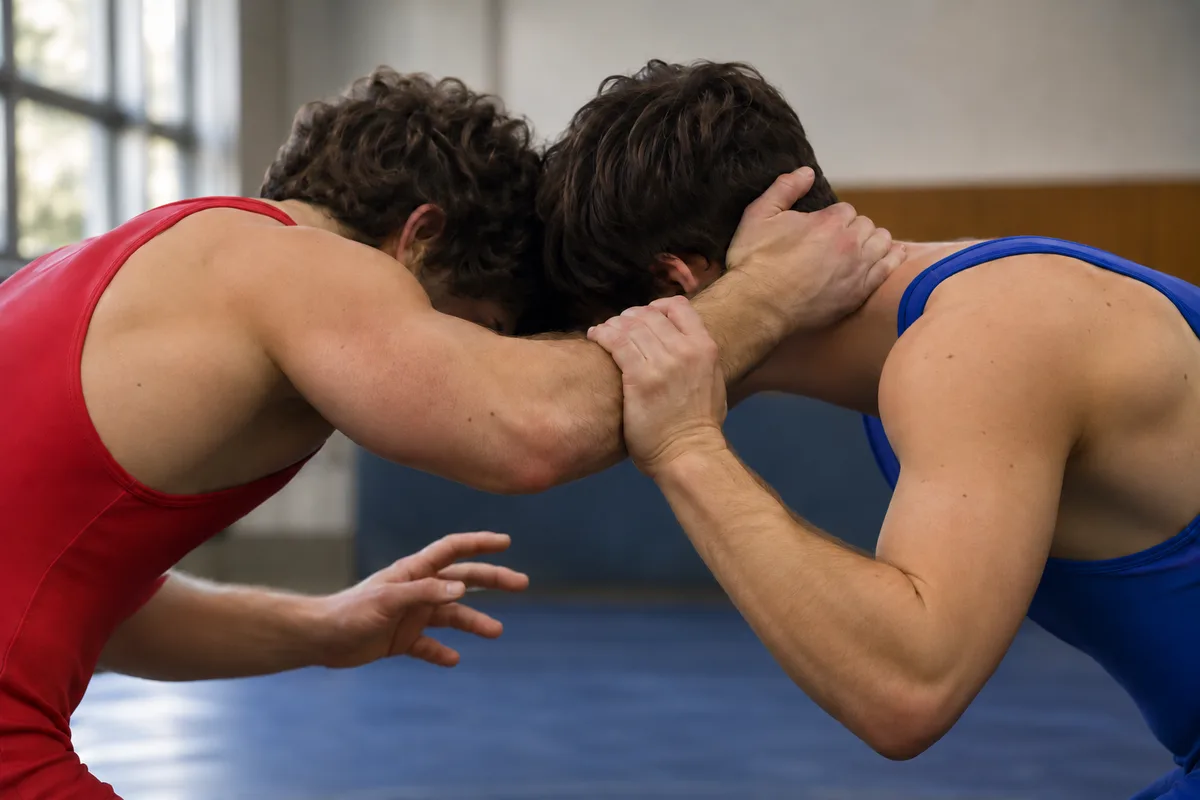
Next, the hand-fight. What did they go for first?
- your wrists
- a collar tie
- an underhook or an overhook
- a two-on-one or an arm drag
- in Greco-Roman, an over-under or a body lock
And once they had it, what came next? Some wrestlers use the collar tie to snap your head down and go to a front headlock; others hold it while they set up a shot. Write down, too, whether they broke your ties or let you keep them.
How and when do they attack?
List the attacks they used. In freestyle and folkstyle that usually means a single leg, a double leg, a high crotch or an ankle pick. In Greco-Roman, look for arm drags, body locks and throws from the upper-body ties. For each attack, jot down:
- the set-up: a snap, a fake, a level change, or none at all (a straight shot from distance)
- the side: which side of you they went to, and for a leg attack, whether it was your lead leg or your back leg
- the timing: early, after the break, or in the final minute
Mark which attacks actually scored. A wrestler who shoots ten times and finishes once is a different problem from one who shoots twice and finishes twice.
How do they defend, counter and scramble?
Start with your own shots. What stopped each one?
- a sprawl
- a whizzer
- a down block
- a front headlock
- just circling away
More useful still: what did they score off your shots? A go-behind, a counter throw, a front headlock that ended in a turn? Note each shot together with the counter that scored off it.
Scrambles get a line as well. Who ended up on top, and what did the opponent do in the scramble that you did not?
What happens at the edge?
Note where on the mat the match was wrestled. Did the opponent walk you to the edge, attack just as you got there, or circle away from it? Did they work their way back to the centre after each exchange? And what did they do when you drove them towards the edge? In freestyle and Greco-Roman a step-out can swing a close match, so note a point lost at the edge as carefully as a takedown.
What do they do on top and on the bottom?
On the mat, write down what they turned you with and how hard it was to stop:
- a gut wrench
- a leg lace (ankle lace) in freestyle
- a lift in Greco-Roman
- a tilt, or a turn from a leg ride, in folkstyle
Then the other half: how well they kept their base underneath, and how they got out. In folkstyle you can also add how the opponent escaped or reversed (stand-up, sit-out, switch) and which position they picked when they had the choice.
How were the points scored, and how did the match change?
Give the scoring its own line, for both of you:
- each takedown, and the attack it came from
- step-outs
- turns and throws
- escapes and reversals in folkstyle
- cautions
Knowing how the points were scored tells you more than a sense of who looked busier, and it is what two of the studies further down counted.
Then the shape of the match. Who scored first? What did the opponent change once they led, or once they trailed? What did they do in the last minute? Write down any passivity or stalling calls, against them and against you; the call itself is enough. If you remember your coach’s advice at the break, add it.
For the result, write what was announced, such as “lost a 7–4 decision” or “pinned in the second period”, not a score pieced together afterwards.
Which patterns can you plan for with your coach?
A page becomes useful once it suggests something to try. The four patterns below are ones wrestlers run into often. Each comes with ideas to work on with your coach in drilling and live wrestling, and a sign that tells you to let the idea go. Treat them as options to test, not instructions.
- Ties you up and snaps you down. They want the collar tie early and use it to snap your head down to a front headlock. Try winning the wrists before they get the tie, or attacking as they reach for it. Let it go if they stop tying up and shoot from outside instead, or if the snap-down keeps coming anyway.
- Shoots at your legs from distance (freestyle and folkstyle). They stay out of the ties and shoot a single or double leg the moment you reach or step in. Try closing the distance with your hands in front of you instead of reaching from outside, so they cannot get underneath. Let it go if they switch to tying up, or if the shot still gets to your legs.
- Wins at the edge. They walk you back and score as you reach the edge, or collect step-outs. Try circling back to the centre before you get there, and attacking when they start walking you back. Let it go if the points start coming in the centre, or if circling opens you up to their shot.
- Turns you on the mat. Once on top they lock a gut wrench (or, in freestyle, a leg lace) and turn you more than once. Try keeping your elbows in so they cannot lock their hands around your waist, and getting back to your base or your feet. Let it go if they turn you with something else, or if staying safe on the bottom starts to make you hold back on your feet.
Choose one or two of these for the rematch, and only the ones your notes actually point to.
What have studies of elite wrestling matches found?
Alfonso Gutiérrez-Santiago of the Universidade de Vigo and colleagues timed the standing, ground and pause phases of 127 men’s freestyle matches at the 2019 World Championships in three weight classes (PLOS ONE, 2023). Roughly three matches in four lasted into the final minute, and about three-quarters of the wrestling time was spent on the feet. The study looked at how time was used, not at who scored or won, and covers one championship.
Georgiy Korobeynikov of the National University of Ukraine on Physical Education and Sport and colleagues went through all 703 freestyle matches at the 2023 World Championships in Belgrade (Health, Sport, Rehabilitation, 2025). For winners and losers, men and women, leg attacks were the most common scoring action. A bigger share of the winners’ scoring actions were takedowns and turns on the mat; a bigger share of the losers’ were step-outs, passivity points and counters on the mat. Because winners are simply the wrestlers who scored more, this describes them rather than explaining their wins.
Mujde Atici of Kahramanmaraş Sütçü İmam University and colleagues in Turkey and Romania studied 54 medal matches at the 2024 European Championships in Greco-Roman, men’s freestyle and women’s wrestling (Applied Sciences, 2025). In Greco-Roman, body locks and arm drags were the most common scores on the feet, and the gut wrench the most common on the mat. In men’s freestyle, the single leg came first on the feet.
In the same matches, step-outs and passivity points accounted for a large share of all scoring — about one scoring action in five in men’s freestyle was a step-out, and in Greco-Roman 27.1% were passivity points. The counts behind each technique are small.
These are observational studies of senior elite events. They cannot show cause and effect or tell you how a club opponent will wrestle, and none of them asked whether keeping notes helps a wrestler win. We read them as a pointer to what is worth writing down: how each point was scored, whether on the feet or on the mat, and what happened in the closing minutes.
What goes on the opponent’s page?
Five headings are enough. The first two are background; the last three are the answers we recommend.
- Context. Event and round, or a practice in your room; style; weight class; the announced result.
- The opponent. Stance and lead side; the ties they wanted and what followed; their attacks, set-ups and which ones scored; how they defended and countered; scrambles; the edge; what they did on top and underneath; who scored first and what changed; passivity or stalling calls and cautions.
- What worked. Whatever scored for you or kept you safe.
- What didn’t work. How you were scored on, and what you had done just before.
- Next time. One or two things to carry in, and for each, the sign that you should let it go.
If a detail is gone, leave the space empty instead of making something up. Unsure how often something happened? “Several times” is better than an invented number. A spot marked on a drawing of the mat is only useful later if it comes with a few words about what happened there.
We suggest writing on the day of the match; that is advice, not something the research proves. Our article on memory and match notes explains why no study can name the moment details fade, but nothing in it argues for leaving the page until later.
Example: a page after a 7–4 loss
The opponent and the match below are invented.
Context: Freestyle, my weight class, regional championships, quarter-final. Lost a 7–4 decision.
The opponent: Staggered stance, right side forward. Went for a collar tie straight away. First period: snapped my head down from the tie, went to a front headlock and spun behind for a takedown, then turned me once with a gut wrench on the mat. Shot a single leg on my lead leg when I reached for a tie from too far away. Once ahead, stayed out of the ties and circled off towards the edge. Passivity call against him in the second period.
What worked: When I got to his wrists first and kept his hands busy, he couldn’t get the collar tie. My single leg on his lead leg scored a takedown in the second period. He can be scored on.
What didn’t work: Reaching for the collar tie from too far away; he shot under it. Standing too upright in the tie; he snapped me down to the front headlock. Gave up the gut wrench on the bottom.
Next time: Hands on his wrists before he gets the collar tie, then the single leg as in the second period. Drop it if he stops tying up and shoots straight away. On the bottom, keep my elbows in so he can’t lock his hands around my waist.
The page links each lost point to what happened just before it: a reach from too far away and the single leg, standing tall in the tie and the snap-down, the gut wrench lock and the turn. It also keeps the second-period takedown, which shows the opponent can be scored on. All of it comes from one match, so it gives you things to look for in the rematch, not predictions.
Reading the page before the rematch, and updating it after
The evening before, or once the bracket is out, reread what you wrote about the opponent and your three answers. Then choose one or two things to focus on. If there is time, drill them with your coach and a training partner: hand-fighting for the wrists against the collar tie, and keeping your elbows in against the gut wrench.
Once the rematch starts, the first exchanges show whether the opponent still wrestles the same way — in the example, whether he still goes straight for the collar tie. Since you last met he may have changed how he wrestles, and so may you.
Then write the rematch up on the same page. Did the plan hold? What caught you off guard? If he wrestles differently now, update the opponent section.
Every so often, go through all your opponent pages and compare what you wrote under “what didn’t work”. When one problem shows up against several different wrestlers (getting snapped down from the collar tie, for instance), bring those examples to your coach. That is a training target, not a flaw you are stuck with.
Our overview of what research says about reflection and sporting performance covers what looking back at your matches can and cannot do; no study in it shows that the writing itself is what makes athletes better. Wrestlers who also do judo can keep the same kind of page there; our judo grip-fighting guide shows what to put on it.
In OpponentBook’s free journal, a wrestling opponent’s profile has fields for style (folkstyle, freestyle or Greco-Roman, or more than one if you meet them in several styles), weight class, stance (square or staggered) and lead side, plus style tags such as “leg attacker”, “heavy hand-fighter”, “snap-and-go” or “scrambler”. You can drop pins on a drawing of the mat for each match and mark each one worked, didn’t work, dangerous or tendency, with a note attached. Notes can also go on named positions such as tie-up, underhook, front headlock, single leg, top and bottom; the app keeps these separate from the pins.
Synced records are saved in the storage you connect; OpponentBook’s account database does not hold a copy of your journal. When you request AI processing, the necessary content passes through an OpponentBook server to the AI provider. Optional end-to-end encryption protects encrypted records from the storage provider, while photos, videos and provider-visible file metadata remain outside that protection. The privacy guide explains these distinctions. Start a free journal.
This evening, pick the last wrestler who beat you. Give them a page with your three answers, and add how they scored on you.