

Fencing
Foil · épée · sabre
For individual-sport athletes
Keep what you learned from each opponent, match and training session. Find it again before your next meeting, on your phone or computer.
See what's free forever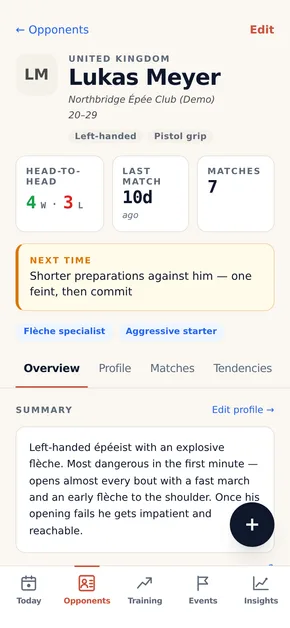
Screens show fictional demo records.
Between one meeting and the next
Add the result and a few notes about what happened.
Put a pin on your sport's drawing and explain the action.
Reread your notes about the opponent and choose an adjustment to test.
Seventeen sports supported
Choose from 17 sports, each with a spatial drawing, profile fields and tags. Some combat sports also provide a separate list of named positions. Kickboxing/Muay Thai and boxing share a ring drawing, and BJJ, judo and kyokushin karate share a mat drawing.
Foil · épée · sabre
Singles or doubles
Singles court
Singles court
Doubles · walled court
Singles court
Tachi-waza + ne-waza
Position-driven
Folkstyle · freestyle · Greco-Roman
Shiai-jō · sanbon-shōbu
Ring
Ring · 3–12 rounds
Cage · standing + ground
WT & ITF sparring
Shōbu ippon · WKF kumite
Knockdown karate
JJIF fighting system
Multi-sport athletes: switch sports freely, keep separate books, on every tier — including Free.
The book
Free includes opponents, matches, training, events, pins, sync, backups and exports. Paid tiers add analytics, training plans and optional AI tools.
A living profile for everyone you face — structured fields, free-form observations, full match history.
Score, score by period, and the three questions that matter — what worked, what didn't, what to remember.
Mark where it happened on your sport's diagram. Choose worked, didn't work, danger or tendency, and add a note to explain the situation.
Attach photos and video as you log the match, then link a pin to the exact second in a video file. No app-imposed count limit — your device and storage capacity still apply.
Keep an event's expected opponents, preparation and results together.
Record sessions, focus and effort alongside your opponent notes, so you can review training and competition together.
Action tags, style tags, training categories and your sport's profile fields all come set up for you. Add the options you actually use, hide the ones you don't, and the book ends up shaped the way you work.
Export an opponent profile, a selection of records or the whole journal to PDF or Word, at no extra cost.
Read locally saved records and write notes at a venue with no signal. Reconnect and open the app to sync through your own storage.
Your storage, your records
Your journal stays on your device and connected storage. OpponentBook keeps account, subscription and usage information, plus a minimal index and settings. Requested AI actions send the relevant content for processing; this is separate from journal storage.
Optional end-to-end encryption also protects journal records from your storage provider. Photos and video are outside this encryption.
How your data is handled →When you want more than memory
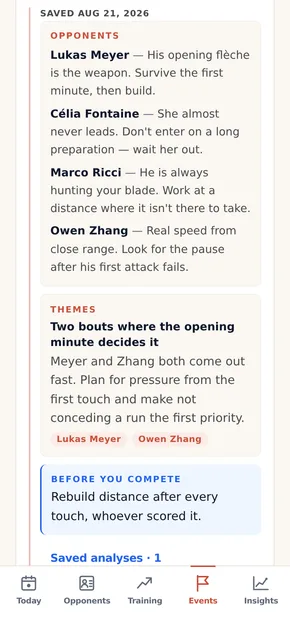
Request an opponent summary, competition brief or analysis of your notes. The content needed for that action passes through OpponentBook to an external AI provider. AI does not review your journal in the background.
Bring the notes about one opponent into a short summary to check before you compete.
Create a competition brief from your notes about the opponents you expect to face.
Explore AI suggestions about opponent styles, recurring problems and changes in your game. Tick a box and the evolution analysis also reads your training journal: it quotes your own notes, sets your training beside your results against each opponent style, and offers one thing to try. It states a gap, never a cause.
AI results you save stay in your storage, even if you cancel a paid plan.
Competition brief Pro
Screens show fictional demo records.
The notebook
Judo grip fighting notes: record an opponent's stance, first grip, attack side and ne-waza habits, then choose two things to test at the next contest.
Practical padel tactics and match notes: watch the lob, the reply and both partners' movements, then agree what to try against the same pair next time.
Tennis opponent analysis for club singles: record serve and return, rally patterns and your own errors, then test two ideas at the rematch.
A name and one useful observation are enough to begin. Add the rest when you have it.
Sign up freeFree forever · No card required · Works offline