Judo grip fighting: read an opponent's kumi-kata and plan the next contest
In this article
After a contest, write down the first grip your opponent took and what followed it. Which hand went where, sleeve or collar? Did they attack straight away, or settle in with two hands and wait? Much of what you can learn about a judoka shows in the exchange before the throw, and that exchange is easy to forget once the next contest starts.
Keep those notes on an opponent page so you can check them the next time the draw puts you together. On regional and national circuits you meet the same people again and again, and a regular randori partner deserves a page too. Before the rematch, read the page with your coach and agree on two things to try.
What should you watch in the grip exchange?
Start with stance. Does the opponent fight right- or left-handed? That is about which hand takes the collar and which takes the sleeve, not about the hand they write with. Add your own stance. Right against right, or left against left, is ai-yotsu; right against left is kenka-yotsu. The pairing decides which grips are easy to reach and which throws fit, and it changes if either of you switches, so record it for each contest rather than as a permanent label.
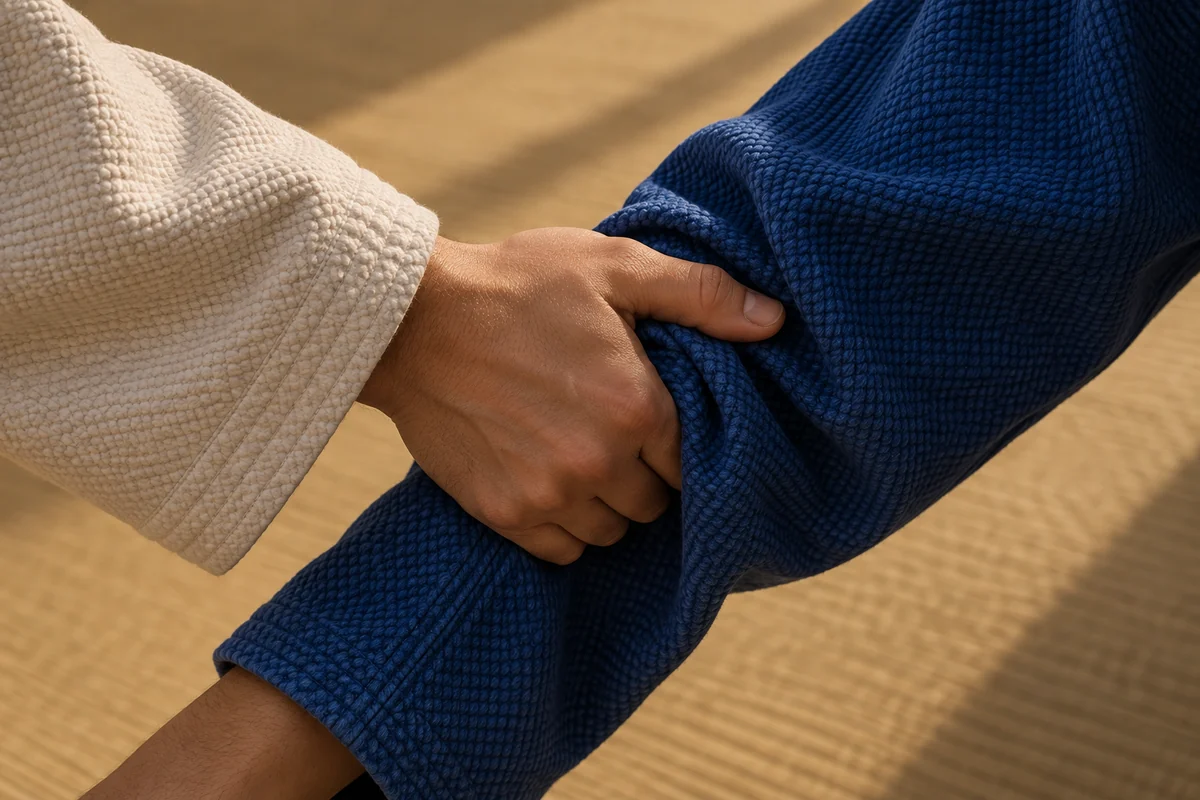
Then watch the first grip. Which hand reaches first, and where does it go: your sleeve, your lapel, high on the collar, over the back, across your body in a cross grip, or to the belt? Some judoka attack off one grip; others wait until both hands are in place. Note how long they keep their grips before they attack, and what they do when you break a grip — go straight back for the same one, switch to something else, or step away and reset.
Watch what they do to your grips as well. An opponent who strips your sleeve grip the moment you take it is showing you where the fight will be. Keep that separate from your own mistakes. If you kept reaching for the lapel first and lost the sleeve each time, that is a note about you.
Which attacks follow the grip?
Record the throws you actually saw, with their direction. Forward or backward, and to which side? An opponent who only attacks forward to the left is a different problem from one who mixes a forward throw with a backward one to the other side. Note the setups — a feint, a pull, a step, a combination — and whether the attack came on the same side as the grip. The research further down explains why that last point matters.
Keep watching after the attack. Did a failed throw end with the opponent in turtle, waiting for the referee? Or did they stand up and re-grip at once, or look for a turnover, a hold-down, a strangle or an armlock? Write only what you saw; one contest does not settle what someone does on the ground.
Finally, look at penalties and pace. Note any shido given to either of you and the reason as you understood it, and what changed late in the contest or in golden score if it went there. There is no need to look up the rule — rules change, and your notes only need what happened.
What does the research say about grips and attacks?
Javier Courel-Ibáñez of the University of Granada, with colleagues at Granada, the University of São Paulo and the University of Niš, analysed 242 contests from 12 World Ranking tournaments in the International Journal of Performance Analysis in Sport (2014). Attacking on the same side as one’s own grip was associated with a higher chance of scoring and of winning, independent of sex and weight category, and same-side attacks in kenka-yotsu were the most effective configuration, especially in the lightest categories. This was systematic observation of elite judoka, not an experiment. For your notes, the useful questions are which side the opponent grips on, which side they attack to, and whether the two match.
Daniel Brandão Kashiwagura and Emerson Franchini of the University of São Paulo mapped 41 studies of kumi-kata in a scoping review in Revista de Artes Marciales Asiáticas (2022). Across that literature, collar-and-sleeve was the most used grip and kenka-yotsu the most common pairing. More experienced athletes held the judogi for less time before attacking; men, especially in the heavier categories, held longer and used more defensive collar-and-collar grips. Those are baselines from mostly elite studies. The note worth keeping is how a particular opponent departs from them.
An older study by Franchini and colleagues in Perceptual and Motor Skills (2008) compared 17 super-elite medallists, the best in each weight category, with 16 other medallists from World Championships and Olympic Games between 1995 and 2001. The super-elite group scored with more different throws, applied in more directions, and that variety correlated with wins. It is an observational study that predates several rule changes and concerns the very top of the sport, but it is a reason to record direction and not only the name of a throw.
A systematic review by Suzan Schoof, Froukje Sliedrecht and Marije Elferink-Gemser at the University of Groningen, published in the International Journal of Sports Science & Coaching (2024), found strong evidence across 23 studies that grip-fighting characteristics separate judoka of different performance levels, alongside the ability to throw and to vary technique. It was written for talent identification, draws on observational studies and says nothing about which grip to take. It is a reason to watch grip fighting closely, not a recipe for it.
Which notes are worth keeping?
Use these five prompts. This is our own template and it has not been tested. None of the studies above asked whether keeping notes improves judo results.
- Context. Event and round, or randori; the opponent; category; the stance pairing; whether the details come from memory, video or your coach.
- Grips. Which grip they took first and with which hand; how they answered your grips; one hand or two before attacking, and how long they gripped first.
- Attacks and ne-waza. Throws and their direction; setups; whether the attack side matched the grip side; what they did after a failed attack; what they looked for on the ground.
- Your own judo. Where you lost the grip exchange, your penalties, moments you were passive, and what worked once.
- Next tests. Two adjustments, each with the condition under which you would abandon it.
Two tests are a limit we chose, not a number from research. Leave blanks where you do not remember. If you mark a spot on a mat sketch, label what happened there.
How could a completed page change your plan?
This is an invented teaching example, not a real athlete’s record or research data:
Context: Regional open, my second contest of the day, against Kasper. We have met once before. He fights left-handed, I fight right-handed, so kenka-yotsu. From memory, plus a phone clip of the second half from my clubmate Mira.
Grips: Right hand to my right sleeve first, every time. Then left hand high on my collar, over the top. He attacked soon after the second hand landed. When I broke the collar grip he went straight back for it.
Attacks and ne-waza: Mostly left uchi-mata, forward; I did not count. Ko-uchi-gari when I bent forward to defend. Both to his left, the same side as his grip. After the uchi-mata failed he dropped to turtle and waited; the referee stood us up.
My own judo: I kept going for the lapel first and lost the sleeve every time. Shido for passivity, I think, while I was trying to re-grip. My o-uchi-gari off a single lapel grip nearly scored once, so my attacks were not hopeless.
Next tests: Get his right sleeve before he gets mine, then attack early off that first grip. Drop it if he starts taking the collar first, or if my attacks still come too late to matter. When he drops to turtle, try the turnover we have been drilling. If he stands straight up or the referee stops it quickly, save the energy for the grip fight.
The useful detail is the sequence: sleeve first, collar second, attack soon after, both attacks to his grip side. A few remembered exchanges cannot tell you how often that will happen next time. Check what you can against the clip, and keep the o-uchi-gari that nearly scored rather than tidying it out of the story.
How do you use the notes before and after a contest?
Read the two tests with your coach and turn each into a short cue. In the first exchanges of the rematch, check whether the pattern still holds. The opponent may have switched stance, moved up a category or changed their first grip since you last met, and your own execution will differ too.
Afterwards, add what worked, what failed and what you are unsure about. Write it up while you can still reconstruct the exchanges, and do not invent counts. Our article on match memory explains why recall deserves care; it does not set a deadline by which a contest is forgotten.
Compare pages across opponents. If you keep losing the sleeve to left-handers, that is a question for randori and uchi-komi rather than for the next draw — ask a partner to take that grip and work from there. The research on reflection and sporting performance covers what reviewing your experience can and cannot do; it does not show that writing things down causes improvement. If your ne-waza notes are growing, the BJJ training-notes article covers recording sequences on the ground.
In OpponentBook’s free journal, judo has a mat drawing where you can place pins, and named positions for standing grips, kuzushi, the main hold-downs and turtle defence, so a note can sit on the position it belongs to. Synced records are saved in the storage you connect; OpponentBook’s account database does not hold a copy of your journal. When you request AI processing, the necessary content passes through an OpponentBook server to the AI provider. Optional end-to-end encryption protects encrypted records from the storage provider, while photos, videos and provider-visible file metadata remain outside that protection. The privacy guide explains these distinctions.
Think back to your last contest or your last hard randori. Write down the first grip the other judoka took, which hand it was, and what came next. Then choose two things to try before you meet them again.