BJJ training notes: record the sequence, then choose what to try
In this article
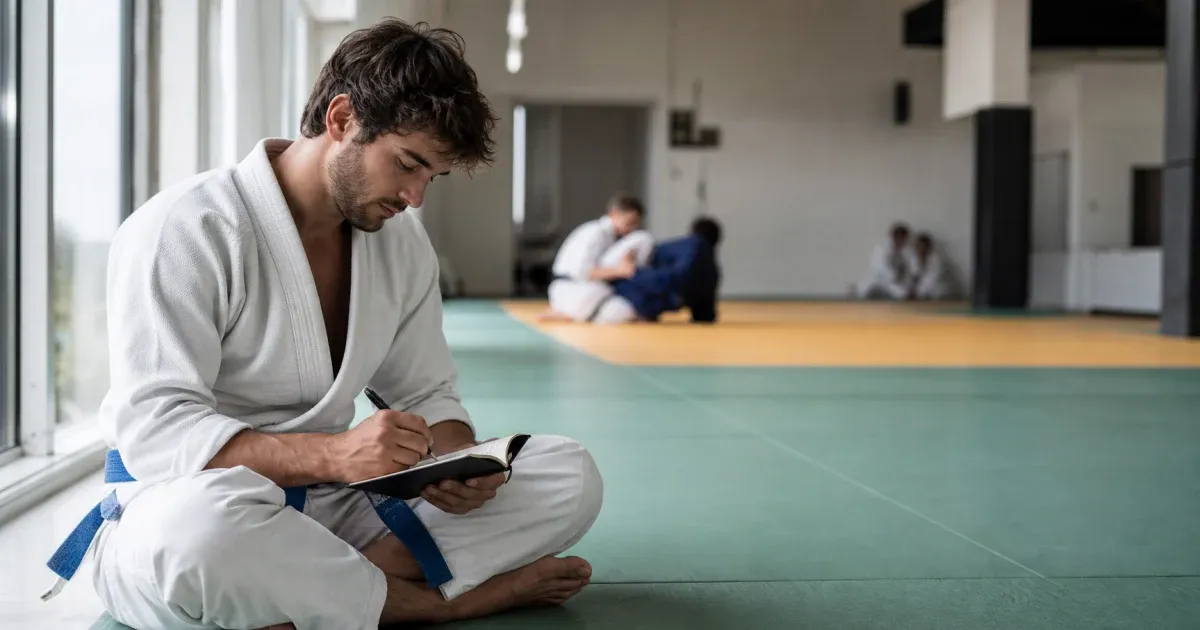
“Got my back taken again” names a problem but leaves out the part you could work on. A training note becomes more useful when it preserves the sequence: where you started, which grip changed, and what happened next.
A BJJ journal can include short observations, longer reflections and video. Choose a format you can return to. The routine below rests on what coaches and athletes have learned in practice.
Follow the chain back to a decision
After a session, record three things: an action that helped, a sequence that caused trouble, and something to try next. These examples are fictional:
- Worked: “Knee cut went much better on the two heavier partners once I had the crossface first.”
- Trouble: “Bottom half guard: lost the underhook, got flattened, gave up my back.”
- Next attempt: “Start positional rounds in bottom half and ask my partner to hunt the underhook.”
The moment you got caught is not the only place to look. A coach may point to an earlier decision as the thing to drill, such as losing the underhook. Record uncertainty instead of inventing a grip or direction you cannot remember.
Keep context about the person as well
An opponent page can also describe a regular training partner. Note size, belt, gi or no-gi, preferred positions and the situations you actually observed. “I shot from too far out and they caught my neck” is more useful than writing that their guillotine is unstoppable.
For a competition, look over the pages of the opponents you expect. Video can help check an assumption, but one match does not tell you how someone always plays. Choose a small adjustment and watch for evidence that it needs to change.
What the research contributes
Murre and Dros’s 2015 forgetting experiment involved one participant relearning nonsense syllables. It did not measure Tuesday’s rolls disappearing by the weekend. When it is practical, write while you can still describe the sequence; the memory article explains why there is no precise deadline for sport.
A questionnaire study of 159 elite and 285 non-elite youth soccer players associated self-reported reflection with playing level. It was not a BJJ journal trial. Ericsson’s deliberate-practice theory offers context for focused work and feedback, not proof that notes cause improvement. The reflection review separates these claims.
Review several sessions with your coach
Look for comparable situations across partners. Bring examples of where the underhook was lost and ask what to change. Your records may be selective, so a recurring note is a lead rather than a diagnosis. Comparing your results after a pre-match review with results without one cannot show that the review caused anything either.
In OpponentBook you can drop a pin on a mat drawing and, separately, attach a note to a named position such as half guard or back control; the app keeps the two as different records. The free journal includes opponent pages (training partners too), matches, training and exports. Records stay on your device and the storage you connect. When you request AI processing, the necessary content passes through an OpponentBook server to the AI provider, and optional end-to-end encryption protects encrypted records from the storage provider but not photos, video or provider-visible file metadata; the privacy guide explains these limits.
After your next session, choose one sequence to describe and one question to take back to the mat.