Boxing tactics: how to read an opponent and plan the rematch
In this article
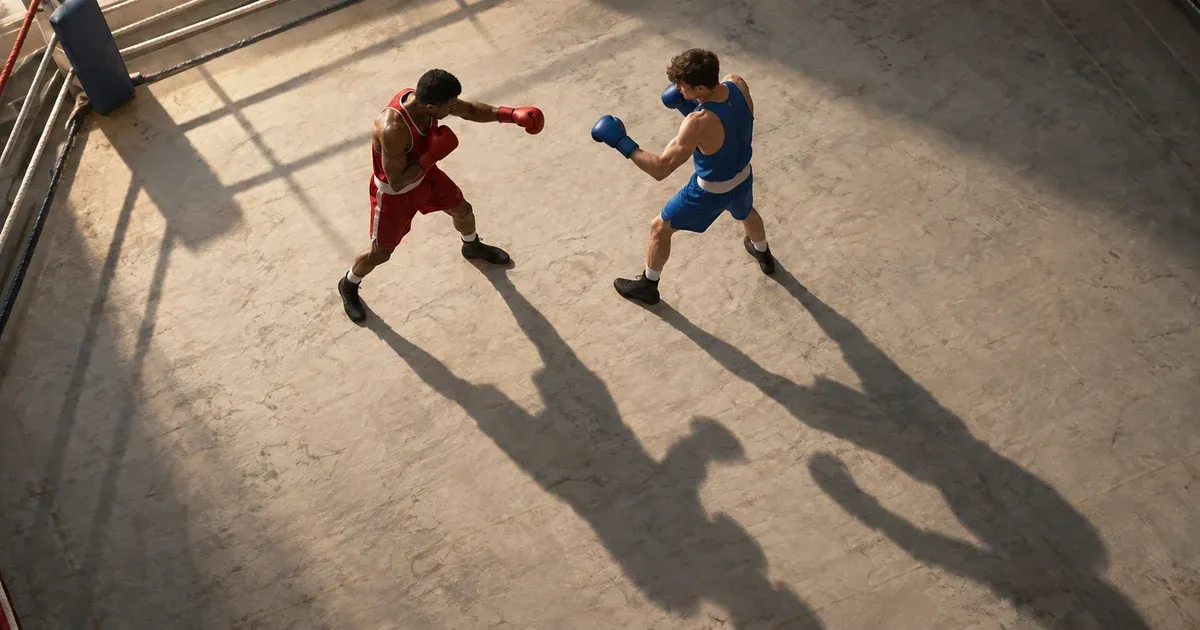
After a bout or a hard spar, write down two things while you still can: what the other boxer’s jab did, and where they went when you pressed them. Were they jabbing to score, to measure the distance or to hide the rear hand behind it? Did they circle out along the ropes, stand and trade, or tie you up? Much of what you can learn about an opponent shows in those habits, and the details blur quickly once the next bout is on your mind.
Keep those notes on an opponent page so they are there when the draw puts you together again. Club shows, regional championships and national championships bring back the same names, and a regular sparring partner deserves a page too. Before the rematch, read the page with your coach and agree on two things to try.
What should you watch for in an opponent?
Start with stance: orthodox or southpaw (right foot forward), and whether they switched during the bout — after they were hit, on the ropes, late on. Note your own stance as well, because the match-up is what matters. Orthodox against southpaw is an open-stance match-up; two orthodox boxers, or two southpaws, make a closed one.
Then look at the guard. A high guard, a shell with the lead shoulder up, a peekaboo guard, low hands — write down what you saw and how they defended: parrying, slipping, rolling, blocking, stepping back or holding. Note where the guard opened, and when.
Watch range and the jab. Did they want to fight at long range, at mid-range or on the inside? Did they lead, or wait for you to throw and then counter? Did the jab score, measure, feint or come doubled? A jab that only paws at your glove tells you something different from one that snaps your head back.
Then the punches. Which punches and combinations did they come back to? Head or body? What did they throw after they missed, and after they were hit? Which of your punches did they counter, and with what? Keep a separate line for what you landed; it matters as much as what they did.
How do you read a southpaw, or an orthodox boxer if you box southpaw?
In an open-stance match-up each boxer wants their lead foot outside the other’s, and the two lead hands keep getting in each other’s way. Write down who got their lead foot outside and what happened when they did. Did the straight rear hand come down the middle when you stepped in? Which way did they move — towards your lead hand or towards your rear hand? Did they try to occupy or trap your lead hand?
Record your own side of it too. If you kept ending up with your lead foot inside theirs, or kept walking onto the same back hand, that is a note about you, and one you can work on. The research further down suggests why stance deserves the top line of the page, though none of it can tell you how a particular southpaw will box.
Where do they go in the ring?
Pressure shows habits quickly. When you pressed, did they back straight up, circle out along the ropes, pivot off, or tie you up in a clinch? Did they always escape the same way? Where did they get stuck — on the ropes, in a corner — and how did they get out? If you were the one being pressed, write down where you ended up and what caught you on the way.
Cutting off the ring is easier against an opponent whose exits you already know. One bout will not tell you whether they always go the same way, but it gives you a question to check early next time.
What changes from round to round?
Write the bout down round by round if you can. Did their output or accuracy change? Did the guard come down after exchanges? Did they start holding when you got close, or stop moving their feet? Describe what they did, not how they felt. “Held whenever I got close in the third” is a note; “they were tired” is a guess. Add what your coach said between rounds, if you remember it.
Record the result as it was announced — unanimous or split decision, stoppage — and leave the scorecards out unless you saw them. There is no need to look up the rule book; rules and scoring guidance change, and your notes only need what happened.
What does the research say about winning bouts?
Emily Dunn of Edith Cowan University and the Australian Institute of Sport, with colleagues, studied 26 elite male boxers at the 2015 Australian Boxing Championships in PLOS ONE (2017). Winners landed a higher share of their punches than losers (33% against 23%), and a smaller share of theirs hit only air, while the total number of punches thrown was similar. Accuracy and movement style together correctly classified 85% of the results. From the first round to the second, clinching and guard drops increased and bouncing decreased; the authors read that as boxers pacing their effort, and those changes did not decide the bouts. This was one national championship, scored under one system. For your notes, the lesson is to record what landed and what missed, not just how busy someone was.
Philip Davis of Combat Sports Performance in Essex, England, and colleagues analysed 60 male boxers in 50 World Championship bouts after the 2013 rule changes for the Journal of Strength and Conditioning Research (2018). Winners threw more straight punches in the first round, including more with the lead hand, landed more punches in the third and, on the authors’ measures, punched more accurately in the second and third. The authors describe elite amateur boxing after the changes as a long-range game of straight punches, with more defence and more movement around the ring, in contrast to the short-range hooks seen before. The sample is elite men at one tournament, and the change of style is the authors’ interpretation, but it is still a reason to record the range, and what the jab and the straight rear hand were doing, round by round.
Edward Thomson and Kevin Lamb of the University of Chester notated 92 English amateur boxers at regional and national level for the International Journal of Performance Analysis in Sport (2016). Bouts were busy, at roughly 25 punches and 10 defensive actions a minute. Boxers at the higher standard did more of both, and winning went with high attacking and low defensive frequencies, while weight class had no consistent effect. It is observational and cannot say that throwing more makes you win. The authors also name the style of the opposition as something future research should look at. Style is exactly what an opponent page records.
Thomas Richardson and R. Tucker Gilman of the University of Manchester studied more than 13,800 professional boxers and mixed martial artists in Scientific Reports (2019), using the stance recorded for boxers in the BoxRec database as a marker of handedness. Left-handed fighters were strongly overrepresented and more successful on average. Among male boxers the advantage showed in both the share of fights won and BoxRec’s rating; among female boxers the rating was higher but the share of fights won was not. These are professionals, stance does not always match handedness, and an average across thousands of fighters says nothing about the southpaw you meet next month. It does suggest the match-up belongs at the top of the page.
Which notes are worth keeping?
Use these five prompts. This is our own template and it has not been tested. None of the studies above asked whether keeping notes improves boxing results.
- Context. The event and the stage of the tournament, or sparring; the opponent; weight; both stances; the result as announced; whether the details come from memory, video or your coach.
- Stance, guard and range. Their stance and any switches; the guard; the range they wanted; what the jab did.
- Punches and the ring. Favourite punches and combinations, counters, head or body; where they went when pressed; ropes, corners and clinches; what changed by round.
- Your own boxing. Where you got caught, what you kept repeating, what landed.
- Next tests. Two adjustments, each with the condition under which you would drop it.
The limit of two tests is our choice, not a number from research. Leave blanks where you do not remember. If you mark a spot on a sketch of the ring, label what happened there; a dot alone is not a note.
How could a completed page change your plan?
This is an invented teaching example, not a real boxer’s record or research data:
Context: Regional championships, semi-final, three rounds, against Toby. We sparred once at an inter-club session. He is southpaw, I am orthodox, so open stance. Lost on a split decision. Written from memory, with what my coach said between rounds and a clubmate’s phone clip of rounds two and three.
Stance, guard and range: Southpaw throughout; I did not see him switch. High guard. Doubled the jab to find the distance, then waited.
Punches and the ring: Each time I stepped straight in, the straight left came down the middle. When I pressed, he circled to my left along the ropes and got out that way every time; his lead foot ended up outside mine. In the third he held whenever I got close, and his hands came down after exchanges. I did not count anything.
My own boxing: Kept following him in a straight line and walked onto the straight left. My lead foot kept ending up inside his. The jab to the body landed twice in the second round, so he was not untouchable.
Next tests: Instead of following him, step to cut off the exit to my left before I throw, and get my lead foot outside his. Drop it if he starts getting out the other way, or if I keep getting caught by the straight left while I step. Keep the body jab, and when his hands come down after an exchange, follow it up to the head. Drop that if his hands stay up this time, or if the straight left keeps coming over my jab.
The useful detail is the sequence: double jab, straight left down the middle, out along the ropes to the same side each time. A few remembered exchanges cannot tell you how often that will happen next time. Check what you can against the clip, and keep the body jab that landed rather than tidying it out of the story.
How do you use the notes before and after a bout?
Read the two tests with your coach and turn each into something you can practise: a pad round on cutting off the exit, a round of supervised sparring against a partner who leads with the right. In the first exchanges of the rematch, check whether the pattern still holds. The opponent may have switched stance, moved up a weight or changed how they move since you last met, and your own boxing will differ too.
Afterwards, add what worked, what failed and what you are unsure about. Write it up while you can still reconstruct the rounds, and do not invent counts. Our article on match memory explains why recall deserves care; it does not set a deadline by which a bout is forgotten.
Compare pages across opponents. If southpaws keep catching you with the same straight left, that is a question for the gym rather than for the next draw. The research on reflection and sporting performance covers what reviewing your experience can and cannot do; it does not show that writing things down causes improvement.
In OpponentBook’s free journal, boxing has a ring drawing with the ropes and the four corners, where you can place pins marked as worked, didn’t work, dangerous or a tendency, each with a note. The opponent’s profile has optional fields for stance (orthodox, southpaw or switch), guard, preferred range (long, mid-range or close), reach and weight class. Synced records are saved in the storage you connect; OpponentBook’s account database does not hold a copy of your journal. When you request AI processing, the necessary content passes through an OpponentBook server to the AI provider. Optional end-to-end encryption protects encrypted records from the storage provider, while photos, videos and provider-visible file metadata remain outside that protection. The privacy guide explains these distinctions.
Think back to your last bout or your last hard spar. Write down what the other boxer’s jab did and where they went when you pressed them. Then choose two things to try before you meet them again.