Table-tennis opponent notes: start with serve and receive
In this article
The opponent’s name is familiar, and so is the serve that troubled you last time. Before your next meeting, it helps to recover what you actually tried on the receive, not just the memory of struggling.
At elite level, match analysis has a substantial literature. Michael Fuchs and colleagues at the Technical University of Munich reviewed its methods in Journal of Sports Sciences in 2018. That review did not test a personal notebook or show that notes replace a video analyst. The format below is a practical way to keep your own observations.
Record the opening exchange
Write the serve’s type, spin, length and placement, then your receive and the next shot. The scouting question is what this player chose in the exchange you are describing.
For example: “Backhand serve from the middle, short sidespin-backspin to my forehand. I was late on the receive and popped it up; he attacked the next ball.” Alongside it: “Short push to his backhand worked twice — the next ball was manageable.” These are invented observations; they are not advice on how to receive.
Add the details you need to recognize the player
Record handedness, shakehand or penhold grip, and whether a penholder uses the reverse side for the backhand. Note the rubbers and the player’s usual distance from the table.
A rubber note might read: “Long pips on the backhand; blocked close to the table. My topspin came back with backspin in those exchanges.” That describes one setup on one day. Rubber, incoming spin and stroke all matter, so not every long-pips or anti return will behave the same.
Watch who opens the attack when a ball comes long. “Plays close to the table” is about where he stands; “flicks short balls” is about a stroke. Keep the two apart.
Put placement on the page
A table drawing can locate a serve or a winning shot. Label the player, the stroke and the point context. The crossover point moves with the player’s body, so a pin on the table cannot mark it; write it in the note instead.
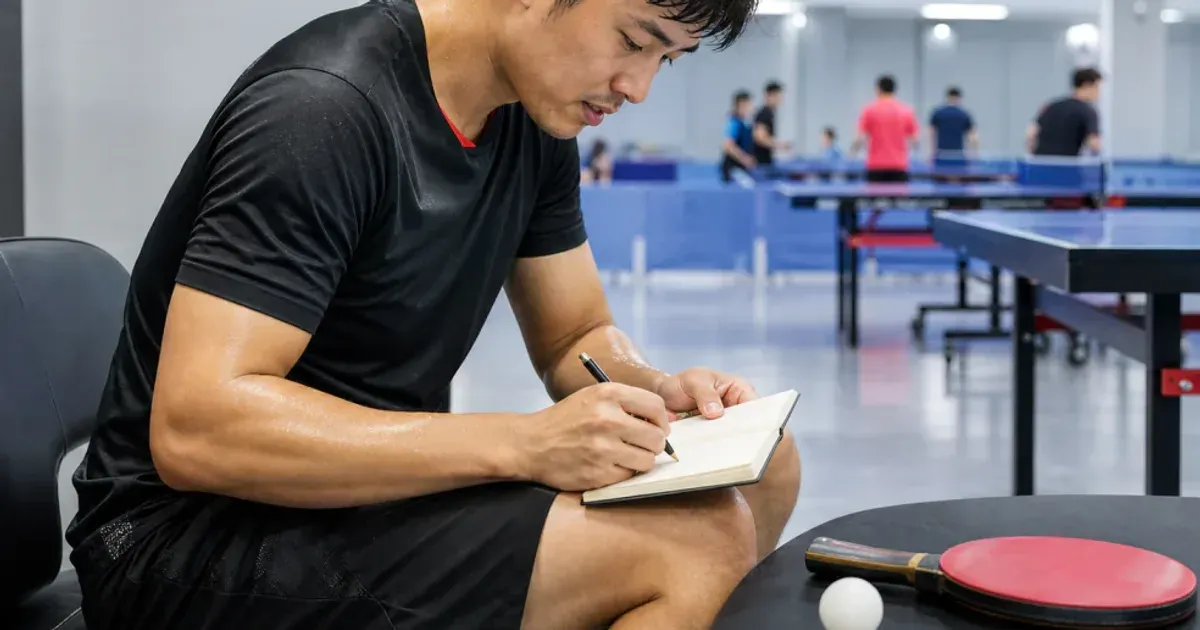
Include your contribution to the point. Did you leave the forehand corner open, return the serve too high or choose an attack you could not control? Write soon after the match if you can and check the note against video when there is any; memory research gives no deadline by which the serve detail disappears.
Take one or two experiments into the next match
Keep a page per opponent. Add a short entry after playing when practical, then reread it before the next fixture. End each entry with three lines: what worked, what didn’t work and what to do next time. In our view, these are the three most important things to record in any racket or combat sport. For that last line, one or two things to try are usually enough; note what would make you abandon each one.
Looking across several pages can give your coach a specific training question. Comparing results from matches with and without a recorded pre-match review is only descriptive; it cannot establish whether the routine caused an improvement. The reflection research points the same way — an association is not proof that the routine works.
OpponentBook provides opponent profiles, table pins, matches and video attachments in the free journal. Records stay on your device and the storage you connect. When you request AI processing, the necessary content passes through an OpponentBook server to the AI provider; optional end-to-end encryption keeps encrypted records from the storage provider, while photos, video and provider-visible file metadata stay outside it. The privacy guide explains both. A paper page is a valid first version.