Kendo shiai: preparing for an opponent you have faced before
In this article
Losing to the same opponent in the same way is hard to take. You go for men from a still kamae, and the same opponent scores debana-kote again, hitting your kote the moment you start. In tsubazeriai, guard pressed against guard, your hands rise as you separate, and their hiki-dō lands again as they step back. Or you are pressed back to the boundary line once more, with no seme of your own left. Extra keiko alone will not necessarily break that pattern.
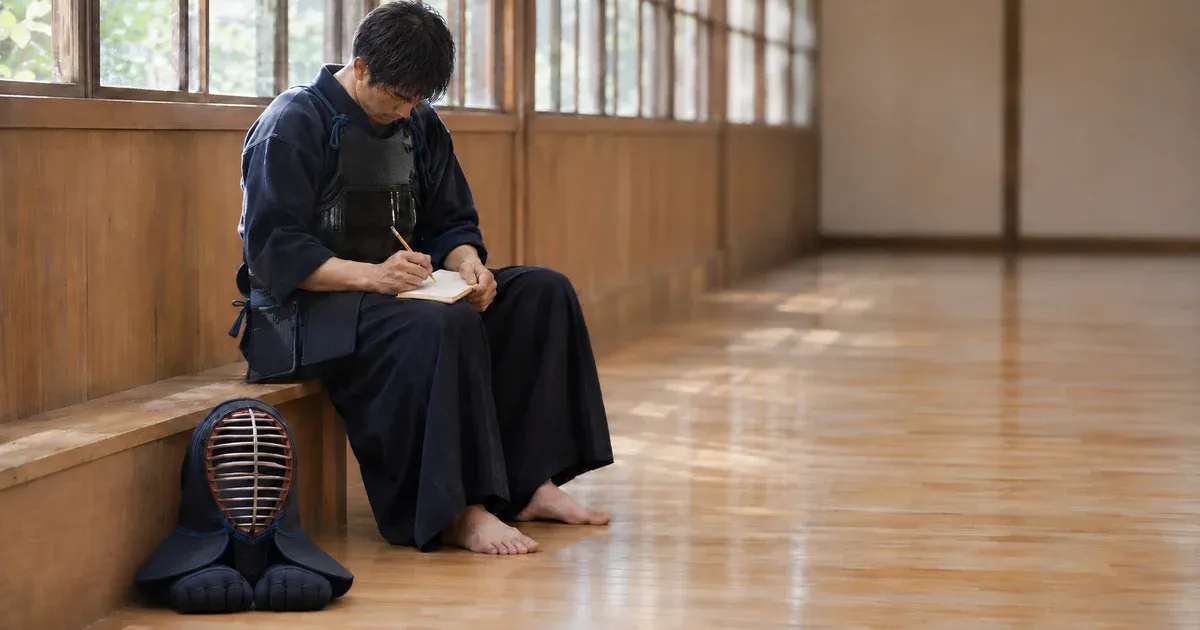
We consider reflecting after every shiai, and writing down what it taught you, one of the most effective ways to improve how you approach a match. Kendo has a saying for the reflecting half of that: utte hansei, utarete kansha (strike and reflect; be struck and be grateful). The writing goes into an opponent book — a notebook, on paper or in an app such as OpponentBook, that gives every opponent you face a page of their own. The page grows by a few lines after each shiai, and you read it before your next meeting.
Each entry is built around three answers — what worked, what didn’t work, and your plan for the next meeting. Around them you record what the opponent actually did, because a month later “lost 1–2” says little without it.
Facing someone for a second time is nothing unusual in kendo — at regional tournaments (taikai) and club cups, in university and club team events, at national championships and, in Europe, at the European Championships, held in the years between World Championships. Some of the people you face most often are keiko partners at your own dojo. The rest of this guide sets out what we suggest looking for in an opponent’s kendo, and what to put on the page.
The core of every page: three answers
Of everything you could note after a shiai, these three answers matter most. That is our view and our recommendation, for kendo as for any combat or racket sport. They sit naturally beside the two questions the All Japan Kendo Federation’s guidebook for junior-high clubs asks players to think about after a match: why did I take ippon, and why did my opponent take one? OpponentBook’s match form has a box for each of the three.
- What worked. What scored or came close, and what set it up, even if it happened only once. Example: “Pressed his centre until he stepped back, then men. Ippon.”
- What didn’t work. How you were struck, and where your seme or posture broke. Example: “Went for men from a still kamae; he scored debana-kote.”
- Next time. One or two things for the next meeting. Each can be a change, or a repeat of something that worked. Example: “Before men, press his centre until he moves, then commit. If he starts striking first instead of waiting, drop it.”
Nothing stops you planning more, but one or two things are usually enough; with more, the plan is already crowded before you bow in.
Kamae, distance and the centre
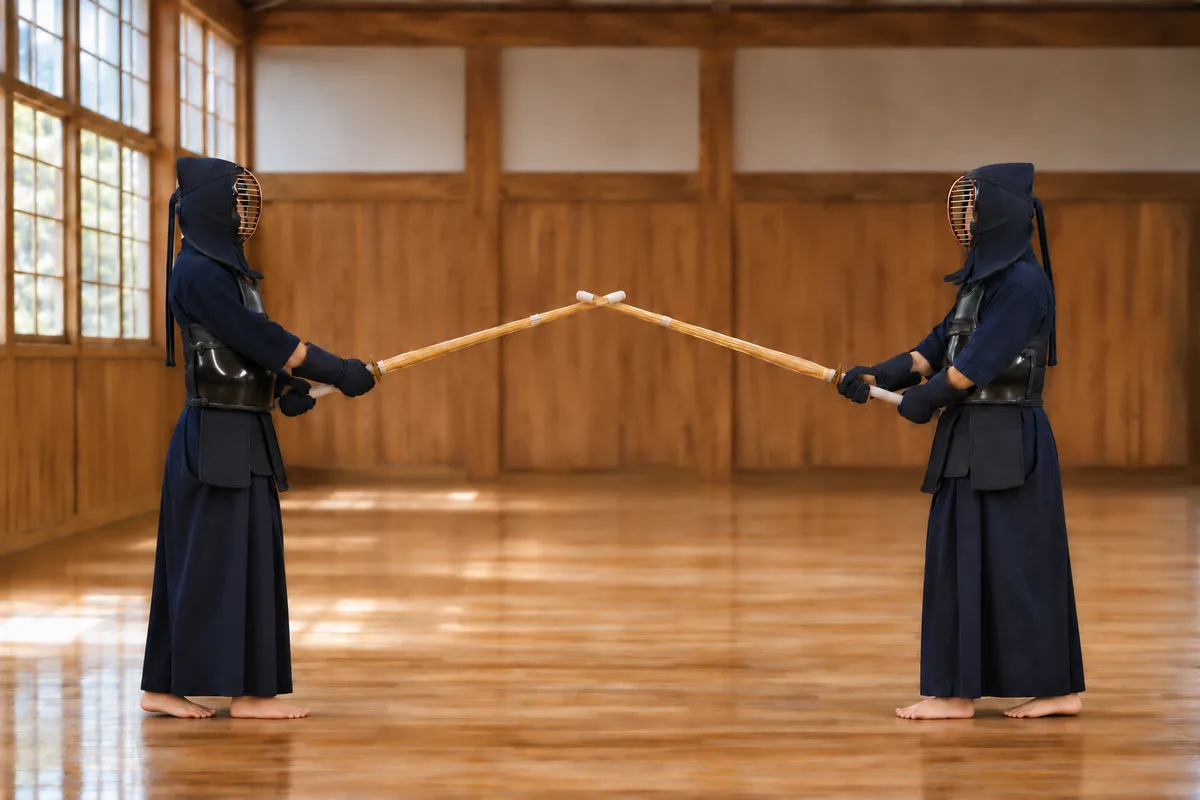
Start with what you saw before anyone struck. Which kamae did the opponent take: chūdan, the middle stance with the shinai pointed at you; jōdan, with the shinai held above the head; or two shinai (nitō)? Where was the tip of their shinai, and how steady was it? Then distance. Striking distance in kendo is the range where one step in lets you strike and one step back takes you out of reach. Some opponents wait at its edge and let you come; others close in until you are almost in tsubazeriai. Note the distance they struck from, and who held the centre for most of the match.
Seme and the start of an attack
Next, look at how they pressured you and how their attacks began. The first sign that a strike is starting may show in a foot, the hands or a dip of the shinai tip. If you noticed one, write down where. And what did they do as soon as the chief referee called hajime? Some opponents strike at once from far away; others spend the first exchanges feeling out your distance.
Then the most useful line on many pages: how they responded to what you did. When you pressed in or touched their shinai, did their hands rise, did they step back, did they hold still, or did they strike? A response that repeats is something you can work with on purpose.
Do they go first, or let you start?
Some players win mostly by going first. They leap straight in from distance with tobikomi-men, or use renzoku-waza such as kote-men, following up at once when the first strike is blocked or falls short. Others wait for you to start, then catch that start with debana-kote or answer your strike with an ōji-waza — they make it miss or deflect it, then strike back. With kaeshi-dō they take your strike on their shinai and turn it into dō; with nuki-men they move so that it misses and strike men. Write down which kind you met. If one technique stood out as their favourite and strongest, note it as their tokui-waza; OpponentBook’s opponent profile has a field for it.
Tsubazeriai, the boundary and the ippon
Give tsubazeriai a line of its own. What did they do there, and what did they do as you separated: hiki-men, hiki-kote, hiki-dō? If you were struck on the way out, note what your hands and feet were doing at that moment.
Note, too, whether they pressed you back towards the boundary, and any fouls (hansoku) against either of you; a second foul gives the other player a point. Then the ippon themselves, in order: who scored, with what, and from what situation. Add the strikes you remember that nearly scored. A few strikes you actually remember will tell you more than an impression of who looked the stronger player.
Finally, what changed after the first ippon, and in encho, the extension where the first point wins, if the match went that far. Write down what the opponent did, not what you think they felt.
What do kendo studies say about knowing an opponent?
Hiromi Miki and colleagues at the University of Tsukuba, writing in the Research Journal of Budo (1998), asked eleven women from one university club to watch a match of each of ten opponents and say how they would fight them. Their plans were based most often on the opponent’s movement features and habits (50% of answers for the team regulars, 58% for the other players) and almost never on their own strengths (5% and 2%).
The authors point out that a first-time opponent’s habits cannot be known without seeing them in a match. They did not test whether the plans worked, and their own advice is to build an approach around your best techniques, adjusted to the opponent.
Motoki Okumura and colleagues, also at Tsukuba, had fifteen third-dan university men fight practice matches and then explain each action from the video (Research Journal of Budo, 2005). Most actions drew only on what the player had seen just before. Of the actions that drew on something learned before or earlier in the match, 29% of the non-regulars’ and 24% of the regulars’ became valid strikes, against 8% of actions based on the moment alone. The players refereed these practice matches themselves and described their actions afterwards, so the study shows an association, not that the information made the strikes score.
Miho Takenaka, Hiroshi Aida and Yoichiro Sasaki at Tsukuba interviewed three retired members of the Japan women’s team, all of whom had placed high at the World Kendo Championships (Japan Journal of Physical Education, Health and Sport Sciences, 2024). What they knew about an opponent changed their plan before the match: whether the opponent’s hands rose when the shinai was pressed, how readily the opponent reacted, the opponent’s reach, and whether the opponent already knew their tokui-waza.
Against someone they knew, they could commit from the first strike; against someone new, they tested first. Three people recalling their careers is a small base, and the authors themselves note the risk of a plan fixed in advance.
All three studies come from one university and its researchers, with small groups of university or elite players, and none of them tested whether keeping notes improves results. What we take from them for your notes: write down the opponent’s habits and how they responded to you, and build the plan from techniques you can actually do.
Four patterns to take to keiko
Kendo teachers describe patterns like these. When a page matches one of them, take the ideas under it to keiko and try them with your teacher. Each comes with a sign that it is not working.
- The opponent who waits and answers. Stands still, lets you come, and scores debana-kote as you start or answers your strike with an ōji-waza. Try a seme that invites their answer and then changes, the kind of invitation Sotaro Honda describes in his articles on tactics for the British Kendo Association, and vary where and how you start. Not working: your feint turns into a half-strike and you are struck as your hands rise.
- The tsubazeriai specialist. Closes in and scores as you separate. Practise correct tsubazeriai with a partner, hands low and centre kept, and separating cleanly. Not working: you are still struck on the way out.
- The opponent who goes at once. Strikes from far away straight after hajime. Try not to answer force with force at the start: meet their start with your own seme or with debana, and practise striking as they finish an attack and turn. Not working: you begin waiting passively and lose your own seme.
- The opponent who backs away. Steps back when you press. Try following and keeping the pressure, or striking as they move back. Not working: you chase and are struck with hiki-waza or as you step in.
If you rarely face jōdan or two shinai, ask someone who takes that kamae for keiko before a taikai. Honda notes that in Japan tactics are quite often thought of negatively, as a way of winning at any cost, and he stresses that his own writing on tactics will never be about pushing the rules to the limit. Use the notes to understand the opponent and to widen your own kendo; the aim is still a committed, correct strike.
What goes on the page
- Context. The taikai and round, individual or team match and your position, sanbon-shōbu or ippon-shōbu (first to two points or to one), the result, and which ippon each of you scored, in order.
- The opponent. Kamae and distance; seme and how their start showed; how they responded to your pressure; whether they went first or waited for you, and their tokui-waza; tsubazeriai and separating; the ippon and the near misses; what changed after the first ippon.
- What worked. Whatever scored or came close, even once.
- What didn’t work. Each strike that scored against you, and what you were doing at that moment.
- Next time. Your one or two plans, and what would show you each one is failing.
Write only what you remember — an empty line is fine, and if you did not count, “several times” will do. A mark on a drawing of the shiai-jō, the match court, needs a few words beside it, or in a month you will not know what it meant.
Our suggestion is to write up each shiai the same evening, before the exchanges blur. That timing comes from us, not from research: the memory studies we have summarised cannot pin down when the details of one match fade.
An example page: losing 1–2 at jihō
This page is invented; no real opponent or match lies behind it. The match was fought at jihō, second in a five-person team.
Context: Regional team taikai, sanbon-shōbu. I fought jihō. Lost 1–2: his debana-kote, then my men, then his hiki-dō.
The opponent: Chūdan, shinai tip very steady. Waited at the edge of striking distance and hardly ever went first. The moment I lifted for men from a still kamae, he took debana-kote; he went for it again later. When I pressed his centre, he stepped back, twice. In tsubazeriai he kept his hands low and struck hiki-dō as I separated with my hands rising.
What worked: Pressing his centre until he stepped back, then men. Ippon.
What didn’t work: Men from a still kamae (debana-kote). Separating from tsubazeriai with my hands coming up (hiki-dō).
Next time: Before men, press his centre until he moves, then commit fully. If he starts striking first instead of waiting, drop it. In tsubazeriai, keep my hands low and centred and separate without lifting them.
Read in order, the page shows what came before each ippon: a still kamae, then his debana-kote; his step back under pressure, then your men; hands rising on the separation, then his hiki-dō. Three exchanges from one match are worth checking when you meet again, but they do not tell you what will happen.
Using the page at the next taikai
Good moments to read it:
- the evening before, once the draw or the team order is known
- between matches, with your men and kote off
- with your teacher, or with your team, before the shiai
Read the opponent section first, then your three answers, and settle on one or two things to carry in. If there is time, practise them in keiko beforehand — for example in ji-geiko (free practice) against a partner who plays that opponent’s style. In a team event, teammates can share what they noticed too; Japan’s school kendo guidance has team members talk through how to deal with an opponent’s tokui-waza.
Once the shiai starts, the opening exchanges are your check on whether the page still fits. Their kendo may have developed since the page was written, and so may yours. When it is over, the new match goes on the same page: did the plan work, what surprised you, and does the opponent section need updating?
Over time, compare your “what didn’t work” answers across different opponents. When one problem costs you ippon against several people (debana-kote every time you go for men from a still kamae, say), take those examples to your teacher. That turns it into a subject for keiko rather than a fixed weakness.
Our review of reflection and sporting performance looks at the wider research on reflecting after competition, and none of it shows that the act of writing, on its own, is what makes you improve. Our judo guide applies the same kind of page to another budō.
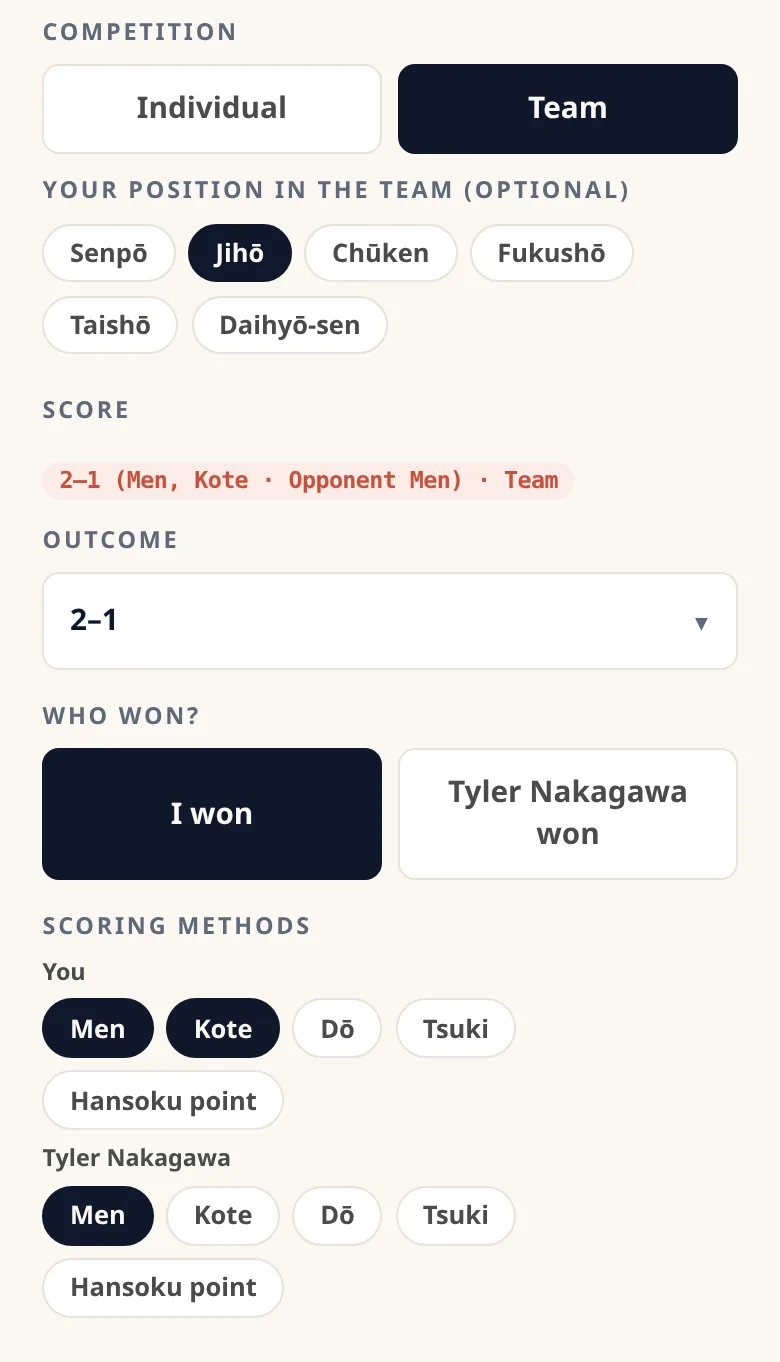
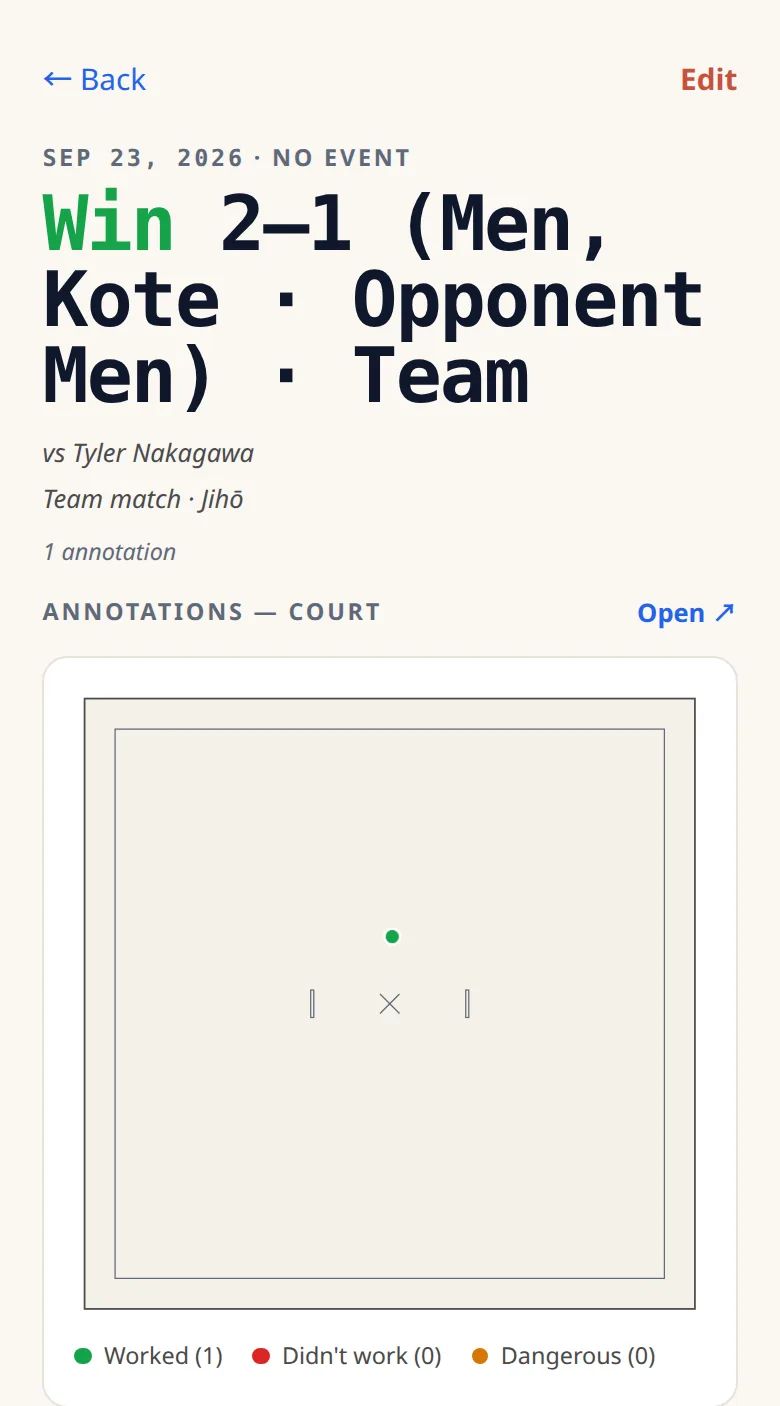
In OpponentBook’s free journal, a kendo opponent’s profile has fields for dan or kyū, kamae and the opponent’s tokui-waza, plus style tags such as “Debana-kote hunter”, “Hiki-waza specialist” and “Patient seme”. A match can also record which targets each of you scored. In a team match you can add your position, from senpō (first) to taishō (last), or the daihyō-sen, the deciding match between team representatives. A jihō win then reads, for example, “Win 2–1 (Men, Kote · Opponent Men) · Team” with “Team match · Jihō” beneath it.
Pins on a plain drawing of the shiai-jō mark what worked, what didn’t, what was dangerous and the opponent’s tendencies; attach a video of the match and you can link a pin to the exact moment. Before a taikai, list the opponents you expect to meet, and the event page shows your record against each, your last match and your note for next time.
Synced records are saved in the storage you connect; OpponentBook’s account database does not hold a copy of your journal. When you request AI processing, the necessary content passes through an OpponentBook server to the AI provider. Optional end-to-end encryption protects encrypted records from the storage provider, while photos, videos and provider-visible file metadata remain outside that protection. The privacy guide explains these distinctions. Start a free journal.
Tonight, open a page for the opponent in the last shiai you lost. Answer the three questions, then add how each of their ippon came. A regular keiko partner is worth a page as well.