Squash tactics: what to note about the opponent who beat you
In this article
Have you ever lost to the same player twice, and in exactly the same way? Once again your opponent cuts off your crosscourts on the volley from the T. Your drop from the back goes into the tin again at 9–9. You spend another match pinned in the back corner on your backhand side. Simply playing more is no guarantee that any of this changes.
We believe that thinking back over every match and writing down what you learned is one of the most effective ways to sharpen your squash tactics. Keep those notes in an opponent book, with a page for every player you face; it can be a paper notebook or an app such as OpponentBook. After each match you add a few lines to the opponent’s page, and you read it before you play them again.
Every entry is built on the same three questions. What worked for you? What did not? What will you change, or repeat, next time? You also record what the opponent actually did (where their length went, whether they volleyed, what they did at the front, how the rallies ended), because a month later the answers mean little without it.
Squash players often face the same opponent more than once — in the next round of the box league, in a league match between your clubs, at the next ranking tournament, or on club night against a regular you play most weeks. A vague memory of losing in four games will not help much then; a page of notes will. The sections below are our suggestions for what to look for in an opponent’s game and what is worth writing down.
Three questions after every match
If you write nothing else after a match, write these three answers. That is our recommendation. In squash, as in any racket or combat sport, we rate them above every other note on the page. The same three questions appear on every match you log in OpponentBook.
- What worked. Rallies you won and how you won them, even if it only happened once. Example: “Straight drives tight on his backhand side kept him in the back corner. That won me the first game.”
- What didn’t work. How you lost rallies: which of your shots they punished, which of yours went into the tin, where they kept you. Example: “My crosscourts from the back didn’t reach the side wall. He volleyed them from the T.”
- Next time. One or two things to take into the rematch. It can be a change, or something that worked and deserves another go. Example: “Mostly straight drives on his backhand side; crosscourt only when it’s wide enough to hit the side wall behind him. If he starts volleying the straight drives as well, change plan.”
Plan as many changes as you like, though one or two are usually enough. A longer list only complicates what you take into the match.
What can you see before the first rally?
You warm up on the same court as your opponent and swap sides halfway, so the warm-up gives you a first look at them. Note which side they seemed more comfortable on, whether they hit hard and flat or slower and higher, and how much they volleyed. Treat it as a first impression to confirm in the first rallies, not a verdict.
Then look at both serves, theirs and yours:
- Their serve. A high lob serve or a hard one, to your forehand or your backhand, and what happened to your return.
- Their return of your serve. Did they volley it, play it straight down the wall, hit it crosscourt, or boast?
Where does their length go, and who gets to the T?
Much of a squash match is played from the back of the court, so this part of the page usually gets the most notes. Look at where their drives went:
- tight to the side wall, or loose in the middle
- deep into the back corner, or sitting up short of the back wall
- mostly to one side, keeping you in the same back corner
Then look at the T. Who got back to it first after a good length? Did they take your drives on the volley from the T, or let the ball go to the back? Write down which of your shots they volleyed, because that is often where a loose ball of yours cost you the rally.
Pace belongs here as well. Some opponents hit everything hard and flat, others slow the game down with height, and some change pace within a rally. Write down which one you faced, and how it suited you.
What do they do at the front, and under pressure?
Next, the short game. Note their drops, boasts, kills and counter-drops: when in the rally they played them, which ones won them the rally and which ones went into the tin. Note where each one came from as well, since a drop played from the back of the court is a different shot from one played on the T.
Some players hold the ball at the front and flick it late. If that happened, note where and how often it caught you out. Write “several times” if you did not count.
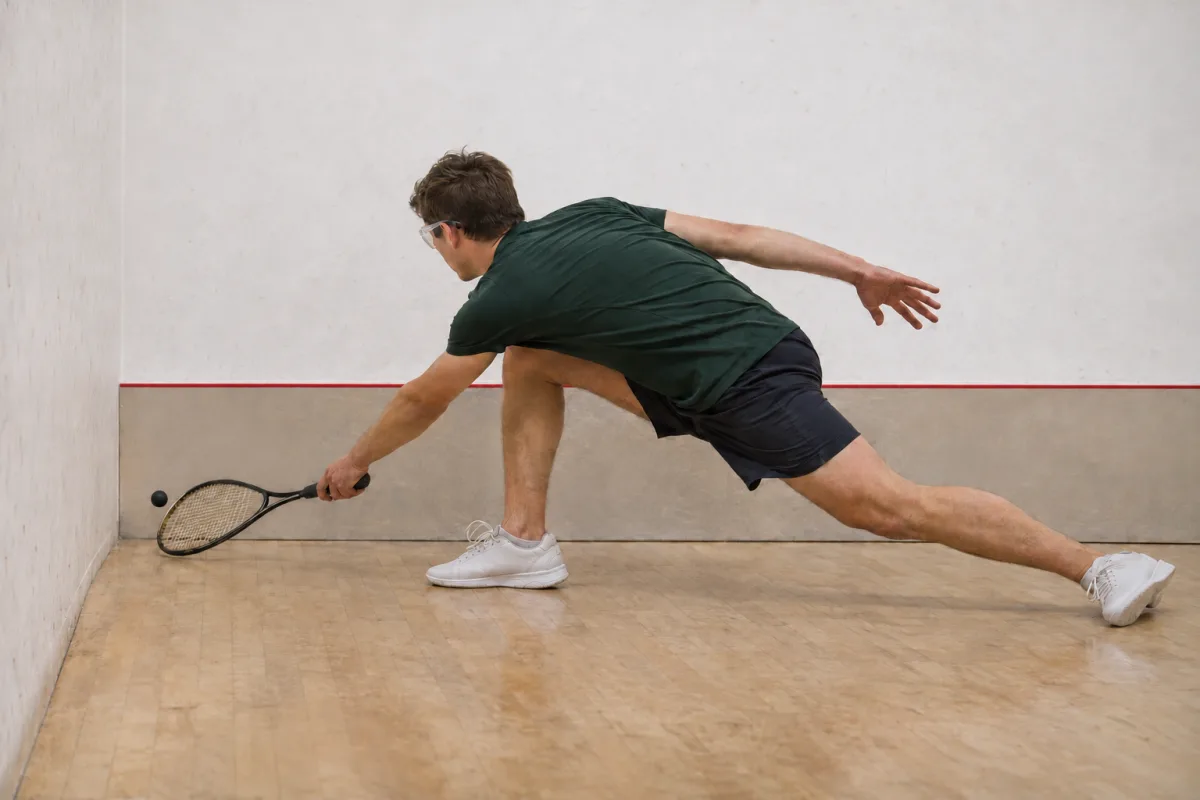
Then look at what they did when you put them under pressure. When you stretched them into a front corner or pinned them deep in a back corner, what was their usual reply? A crosscourt lob, a boast, a straight drive, a high ball to get back to the T? And when they had time, did they do something else? A reply they fall back on whenever they are rushed is one of the most useful things on the page, because you can be ready for it.
How were the rallies won and lost?
Give the end of the rallies a few lines of their own, for both of you:
- Their winners. Which shots won them rallies: volleys, drops, kills, nicks, a drive that died in the back corner.
- Their errors. Which shots they put in the tin or out.
- Your lost rallies. Which loose balls of yours they punished, and which of your shots went into the tin or out.
- Lets and strokes. Only if there were many, and where on court they happened.
What you remember about how rallies actually ended is worth more than a general sense of who played better.
What changed from game to game?
Squash gives you a match in chapters. Who started better? What did the opponent change after winning or losing a game? What happened at the end of the close games, from 8–8 or 9–9 onwards? Your coach’s advice between games, if you remember it, belongs here too.
For the result, write the score game by game, with your own points first each time: “lost 1–3 (11–7, 8–11, 9–11, 6–11)”, for example.
What does research on professional squash say?
Stafford Murray of High Performance Sport New Zealand, with Nic James of Middlesex University and colleagues at the University of Ljubljana, analysed nine matches involving the men’s world number 1 and number 2 at the 2011 British Grand Prix (Frontiers in Psychology, 2019). They grouped the shots played during the rallies by how much pressure each put on the opponent, from defence to attack, leaving out serves, returns of serve and the shots that ended rallies.
Each match showed a different pattern. The number 1 played about 31% defensive shots against an opponent ranked outside the top 24, and about 22% against a top-8 opponent. The authors conclude that, at elite level, a playing profile that does not depend on the opponent is very unlikely. It is a study of two players at one tournament, without statistical tests between the matches.
Goran Vučković of the University of Ljubljana and colleagues in Britain and Croatia tracked about 10,000 shots in ten matches between right-handed players at the 2003 men’s World Team Championships (Journal of Sports Science and Medicine, 2013). Straight drives were the most common shot, about 42% of the total, and most shots were played from the back of the court, above all from the back corner on the backhand side.
In the same matches, a player short of time in the front corner on the backhand side (front left, since every player was right-handed) replied with a crosscourt lob about 44% of the time, against about 14% with more time to play. The less time players had, the fewer different shots they used. The matches were played under the old scoring, and the study did not look at who won the rallies.
Jan Carboch and Přemysl Dušek of Charles University in Prague coded about 28,000 shots from 25 PSA World Tour matches, 14 men’s and 11 women’s, played between 2018 and 2020 (Journal of Physical Education and Sport, 2023). Men and women alike hit about two backhands for every forehand, and about one shot in five was a volley.
Of the errors they recorded, about two-thirds went into the tin (69.5% for men, 62.7% for women), and about a quarter never reached the front wall. Note that this is two-thirds of the errors, not of the rallies. The study had one coder and a small sample of matches from online video, all between right-handed players.
All three are observational studies of professional squash. None looked at club players, and none asked whether keeping notes helps anyone win. We read them as support for a few habits: write down how an opponent played against you rather than their reputation, note their usual reply under pressure in each corner, and note which shots went into the tin.
Four kinds of opponent, and what you could try against them
Coaches tend to sort squash opponents into a handful of styles. If your page points to one of the four below, the ideas under it are for you and your coach to try in drills and conditioned games. Under each one you will also find the sign that an idea is not working.
- The volleyer. Takes your drives and crosscourts early from the T and goes short often. Try keeping your drives tight to the side wall, playing crosscourts wide enough to hit the side wall past them, and lobbing high over their reach. Abandon it if they start leaving the ball to the back and attacking from there, or if your higher balls sit up for them.
- The retriever. Gets almost everything back, so the rallies run long and winners are rare. Try varying pace and height, staying patient with your length, and going short only when their ball is loose and you are in front of them. Abandon it if your short balls keep coming back as winners for them, or if the long rallies keep ending with your mistakes.
- The hard hitter. Plays fast and flat. Try slowing the game down with height (a high serve, high lobs, high crosscourts), keeping the ball tight, and taking your time before you serve. Abandon it if they volley your slower balls away, or if the height gives them easy balls at the back.
- The deceptive player. Holds the shot and flicks it late, mostly at the front. Try watching the ball rather than the swing, waiting until they strike it before you move, standing a little further up on the T, and keeping the ball tight so they have fewer balls to set up. Abandon it if moving later lets their drives get past you to the back.
None of this is a prescription; use only the ideas your own page points to.
How to lay out an opponent’s page
A page needs no more than five parts. Start with the context and the opponent, then add your three answers.
- Context. Box league, ladder, league match, tournament round or a friendly; best of three or five; the result game by game; the opponent’s hand.
- The opponent. The warm-up; serve and return; their length and width; the T and their volleying; pace; their short game and their reply under pressure; how they won and lost rallies; what changed between games.
- What worked. Whatever won you rallies, even once.
- What didn’t work. The rallies you lost, and the shot of yours that came before each one.
- Next time. What you want to try, and for each idea the sign that it is not working.
Leave out what you cannot remember; a blank is more honest than a guess. And if you mark a spot on a drawing of the court, add a few words saying what happened there, or the mark will mean nothing in a month.
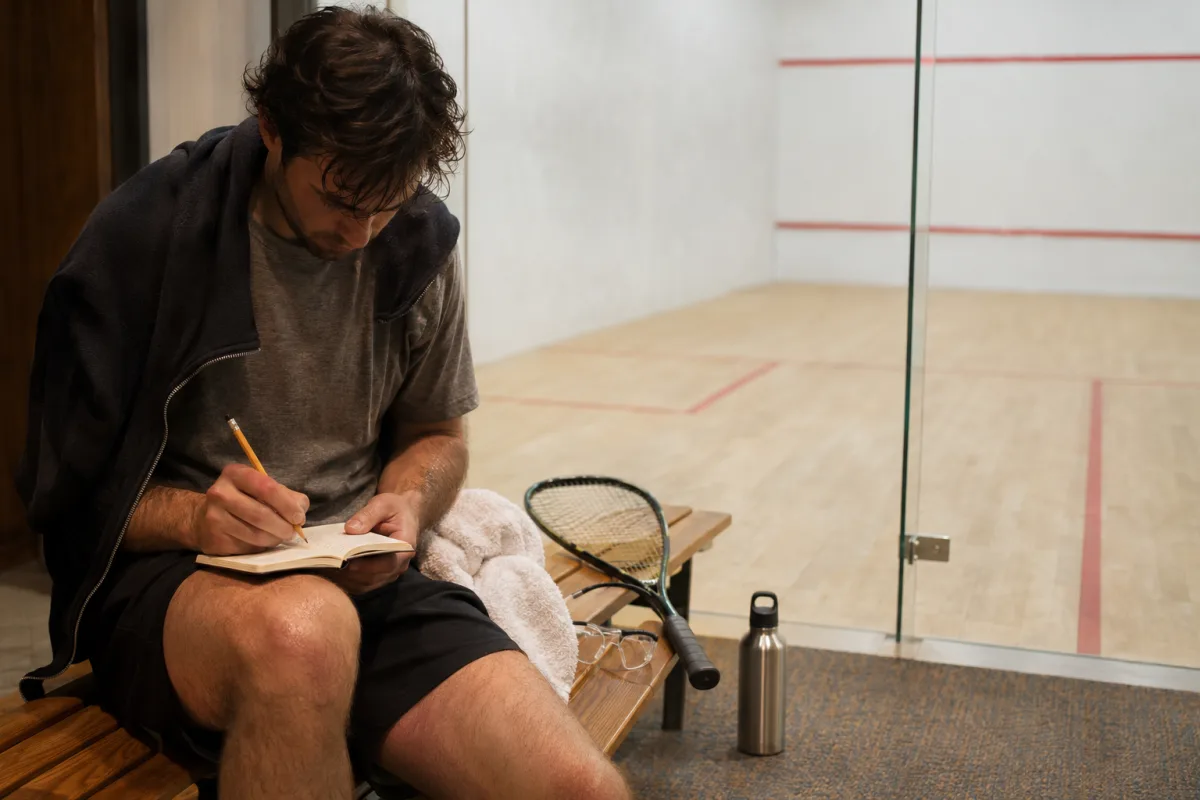
We suggest writing the page on the day of the match, while you can still replay the rallies in your head. That timing is our advice, not a research finding — the studies in our article on memory and match notes cannot say when the details of a particular rally fade.
Example: a page after a 1–3 loss in the box league
We made up this opponent and this match.
Context: Club box league, best of five. Lost 1–3 (11–7, 8–11, 9–11, 6–11). He is right-handed.
The opponent: Hit hard and flat in the warm-up and volleyed a lot. Served high to my backhand. Whenever my crosscourts didn’t reach the side wall, he volleyed them from the T, mostly straight to the front or with a volley drop. When I stretched him into the front corner on his backhand side, he replied with a crosscourt lob several times. In the first game he played drops from the back and put several in the tin. After that he played fewer of them and more length.
What worked: Straight drives tight on his backhand side kept him in the back corner. That is how I won the first game.
What didn’t work: Crosscourts from the back that didn’t reach the side wall; he volleyed them. My boast from the back, which he picked off at the front. At 9–9 in the third I went short from the back twice and lost both rallies.
Next time: Mostly straight drives on his backhand side, and crosscourt only when it’s wide enough to hit the side wall behind him. If he starts volleying the straight drives as well, change plan. At the end of a close game, keep the ball deep instead of going short from the back.
The page links each lost rally to what came just before it — a loose crosscourt, then his volley; a short ball from the back at 9–9, then a lost rally. It also records his crosscourt lob when stretched into the front corner on his backhand side, which you can now be ready for, and the first game, which shows how he can be beaten. One match is a small sample, though, so treat these as clues to watch for in the rematch, not as odds.
Before the rematch, and after it
Read the page the evening before, or when the box-league fixtures come out: the opponent section first, then your three answers. Settle on one or two things to take on court. If there is time, practise them with your coach or a training partner, for example in a conditioned game where only straight drives are allowed.
In the rematch, the warm-up and the first few rallies will show whether the opponent still plays the same way. Against the player in the example, the first question would be whether he still volleys every crosscourt that does not reach the side wall. Either of you may have changed something since the last meeting.
When the rematch is over, add it to the same page: how the plan went, and anything that caught you out. If the opponent’s game has changed, rewrite their section.
Once you have pages on a few opponents, read the “what didn’t work” sections one after another. If one problem, such as loose crosscourts volleyed from the T, costs you rallies against several different players, take those examples to your coach. Then it becomes something concrete to train, not a weakness you have to live with.
Studies on reflection in sport are gathered in our review of reflection and sporting performance. None of them shows that writing things down is, in itself, what makes a player improve. If you also play tennis, our tennis opponent analysis uses the same kind of page.
In OpponentBook’s free journal, a squash opponent’s profile records their hand, their pace (slow, medium or hard-hitting) and their swing style (wristy, compact or long swing), plus style tags such as “Shotmaker”, “Grinder / retriever”, “Volley hunter” or “Deceptive (holds & delays)”. After a match, tap a plain drawing of the court to pin where something happened. Mark each pin as worked, didn’t work, dangerous or tendency; it can also hold your shot, their shot and a note.
Synced records are saved in the storage you connect; OpponentBook’s account database does not hold a copy of your journal. When you request AI processing, the necessary content passes through an OpponentBook server to the AI provider. Optional end-to-end encryption protects encrypted records from the storage provider, while photos, videos and provider-visible file metadata remain outside that protection. The privacy guide explains these distinctions. Start a free journal.
Who was the last player to beat you? Give them a page tonight. Answer the three questions first, then list the shots that won them their rallies.